ترجمه عمران - 20 صفحه
سال 2016
Influence of recycled aggregates on properties of self-consolidating concretes
تاثیر سنگدانههای بازیافتی بر خواص بتن خودتحکیم
Lilia Señasa, Carla Prianoa,Silvina Marfilb
http://www.sciencedirect.com/science/article/pii/S0950061816303749
دانلود رایگان مقاله انگلیسی - خواص بتن خود متراکم
چکیده
سنگدانههای بازیافتی از بتنهای دور ریز خردشده ساخته میشوند و از آنها میتوان به عنوان جایگزین سنگدانه طبیعی در تولید بتن استفاده کرد. با وجود داشتن چگالی کمتر و جذب بالاتر نسبت به سنگدانههای طبیعی، میتوان آنها را برای تولید بتنهای معمولی با عملکرد خوب مورد استفاده قرار داد در صورتی که با مقادیر مناسب افزوده شوند. برای ساخت بتن خودتحکیم، از همان سنگدانههای مورد استفاده در تولید بتن معمولی میتوان استفاده کرد، اما به منظور افزایش مقاومت تفکیکی و حفظ انسجام مخلوط، به مقدار زیادی سنگدانههای خوب و مواد افزودنی مناسب نیاز است. هدف اصلی از این کار، مطالعه تاثیر سنگدانههای بازیافتی بر بتن خودتحکیم است. بتنها با 50% سنگدانه درشت به جای سنگدانههای بازیافتی (شن پاتاگونیا) و با 20% سنگدانه ریز (ماسه طبیعی) به جای پودرهای بتن مخلوط شدند. خواص بتن تازه مورد آزمایش قرار گرفت و خواص فیزیکی و مکانیکی آن در حالت سفت شده، تعیین شد. ترکیب پتروگرافی بتن برای ارزیابی ناحیه گذار سطحی و نسبت پودر در ریزبافت ملات مورد بررسی قرار گرفت. نتایج بسته به نوع مواد افزودنی و سنگدانه متفاوت است. با این حال، نشان داده شده است که استفاده از این سنگدانههای شکسته برای ساختن بتن خودتحکیم خوب، امکانپذیر است.
Highlights
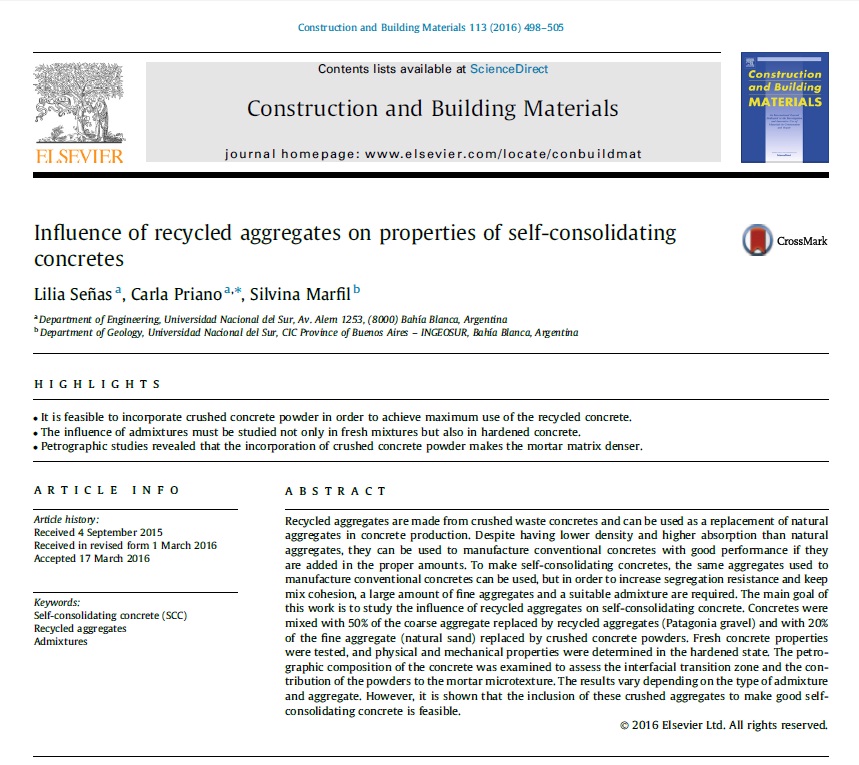
It is feasible to incorporate crushed concrete powder in order to achieve maximum use of the recycled concrete.
The influence of admixtures must be studied not only in fresh mixtures but also in hardened concrete.
Petrographic studies revealed that the incorporation of crushed concrete powder makes the mortar matrix denser.
Abstract
Recycled aggregates are made from crushed waste concretes and can be used as a replacement of natural aggregates in concrete production. Despite having lower density and higher absorption than natural aggregates, they can be used to manufacture conventional concretes with good performance if they are added in the proper amounts. To make self-consolidating concretes, the same aggregates used to manufacture conventional concretes can be used, but in order to increase segregation resistance and keep mix cohesion, a large amount of fine aggregates and a suitable admixture are required. The main goal of this work is to study the influence of recycled aggregates on self-consolidating concrete. Concretes were mixed with 50% of the coarse aggregate replaced by recycled aggregates (Patagonia gravel) and with 20% of the fine aggregate (natural sand) replaced by crushed concrete powders. Fresh concrete properties were tested, and physical and mechanical properties were determined in the hardened state. The petrographic composition of the concrete was examined to assess the interfacial transition zone and the contribution of the powders to the mortar microtexture. The results vary depending on the type of admixture and aggregate. However, it is shown that the inclusion of these crushed aggregates to make good self-consolidating concrete is feasible.
Keywords
Self-consolidating concrete (SCC); Recycled aggregates; Admixtures