ترجمه کامپیوتر-16 صفحه
سال 2015
Self-Organizing Scheme Based on NFV and SDN
طرح خود سازمانی بر اساس معماری NFV و SDN برای شبکه های ناهمگن آینده
Na Chen-Bo Rong-Abdel Mouaki-Wei Li
http://link.springer.com/article/10.1007/s11036-015-0630-3
دانلود رایگان مقاله انگلیسی- طرح خود سازمانی بر اساس معماری NFV و SDN
چکیده
شبکه های سلولی در آینده از ظرفیت بالا و ناهمگونی برخوردار خواهند بود. ساختار و معماری نیازمند راندمان و مقیاس پذیری بالا در عملیات شبکه و مدیریت است. در این مقاله، ما نیازها و چالش های اصلی شبکه های سلولی در آینده را بررسی می کنیم و به معرفی مجازی سازی تابع شبکه (NFV) با شبکه های تعریف شده با نرم افزار (SDN) می پردازیم تا طرح خود سازمان (SO) را تحقق ببخشیم. NFV لوازم سخت افزاری را در سرورهای استاندارد صنعت با یکدیگر ترکیب می کند. و SDN به عنوان کنترلگر هسته ای شبکه عمل می کند.بنابراین طرح پیشنهادی خودسازمانی در چارچوب استفاده مجدد از فرکانس کسری (SFFR) است. این طرح مطالبات ترافیکی متفاوتی را لحاظ می کند و توان را به طور انطباقی تخصیص می دهد.در نهایت، ثابت می شود که سیستم بسیار مقیاس پذیر، کم مصرف از لحاظ مصرف انرژی و هوشمند است.
کلمات کلیدی: SO · NFV · SDN · SFFR
Abstract
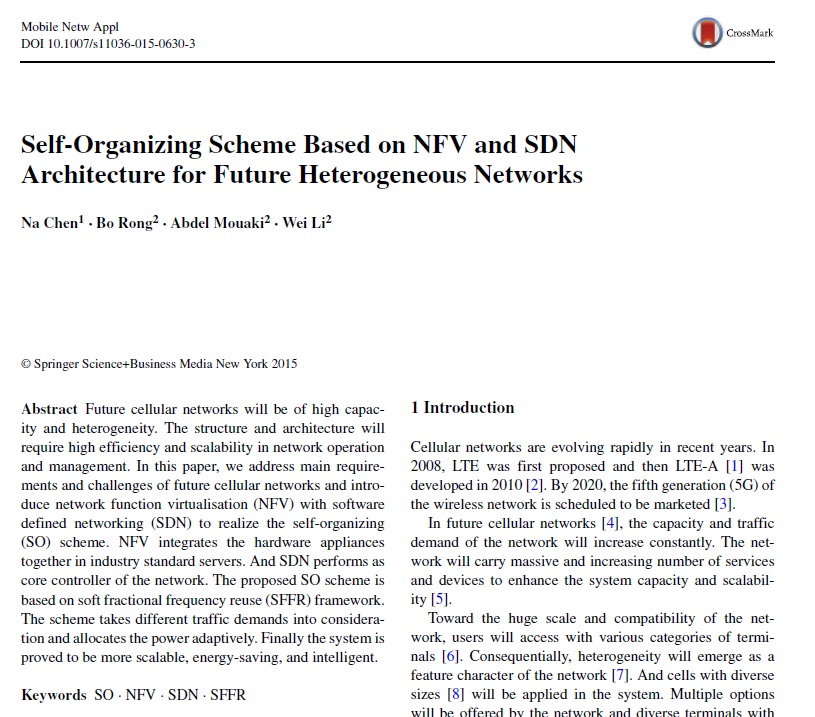
Future cellular networks will be of high capacity and heterogeneity. The structure and architecture will require high efficiency and scalability in network operation and management. In this paper, we address main requirements and challenges of future cellular networks and introduce network function virtualisation (NFV) with software defined networking (SDN) to realize the self-organizing (SO) scheme. NFV integrates the hardware appliances together in industry standard servers. And SDN performs as core controller of the network. The proposed SO scheme is based on soft fractional frequency reuse (SFFR) framework. The scheme takes different traffic demands into consideration and allocates the power adaptively. Finally the system is proved to be more scalable, energy-saving, and intelligent.
Keywords
SO NFV SDN SFFR
References
Li Q, Hu RQ, Qian Y, Wu G (2012) Cooperative communications for wireless networks: techniques and applications in LTE-advanced systems. IEEE Wireless Commun 19(2):22–29Google Scholar
Peng M, Liang D, Wei Y, Li J, Chen H-H (2013) Self-configuration and self-optimization in LTE-advanced heterogeneous networks. IEEE Commun Mag 51(5):36–45CrossRefGoogle Scholar
Kerpez KJ, Cioffi JM, Ginis G et al (2014) Software-defined access networks. IEEE Commun Mag 52(9):152–159CrossRefGoogle Scholar
Lu K, Qian Y, Chen HH (2007) A secure and service-oriented network control framework for WiMAX networks. IEEE Comm 45(5):124–130CrossRefGoogle Scholar
Lu K, Qian Y, Guizani M, Chen HH (2008) A framework for a distributed key management scheme in heterogeneous wireless sensor networks. IEEE Trans Wireless Commun 7(2):639–647CrossRefGoogle Scholar
Hou I, Chen CS (2013) An energy-aware protocol for self-organizing heterogeneous LTE systems. IEEE J Select Areas Commun 31(5):937–946CrossRefGoogle Scholar
Hu RQ, Qian Y (2013) Heterogeneous cellular networks. Wiley
Yan Y, Qian Y, Sharif H, Tipper D (2012) A survey on cyber security for smart grid communications. IEEE Commun Surveys Tutor 14(4):998–1010CrossRefGoogle Scholar
IEEE C802.16m-08/782, Fractional frequency reuse in uplink, LG Electronics (2008) www.ieee802.org/16/tgm/contrib/C80216m-08782.doc
Donghee K, Ahn JY, Kim H (2011) Downlink transmit power allocation in soft fractional frequency reuse systems. ETRI J 33(1):1–5CrossRefGoogle Scholar
Lu K, Qian Y, Chen HH, Fu S (2008) WiMAX networks: from access to service platform. IEEE Netw 22(3):38–45CrossRefGoogle Scholar
Lim J, Hong D (2011) Management of neighbor cell lists and physical cell identifiers in self-organizing heterogeneous networks. IEEE J Commun Netw 13(4):367–376CrossRefGoogle Scholar
Aliu OG, Imran A, Imran MA, Evans B (2013) A survey of self organisation in future cellular networks. IEEE Commun Surv Tutor 15(1):336–361CrossRefGoogle Scholar
Fu S, Lu K, Qian Y, Varanasi M (2007) Cooperative network coding for wireless Ad-Hoc networks. In: Proceedings of IEEE Globecom2007. Washington
Bellavista P, Corradi A, Giannellin C (2008) Mobility-aware middleware for self-organizing heterogeneous networks with multihop multipath Connectivity. IEEE Wireless Commun Mag 15(6):22–30CrossRefGoogle Scholar
Qi F, Sun S, Rong B, Hu RQ, Qian Y (2014) Cognitive radio based adaptive SON for LTE-A heterogeneous networks. In: IEEE global communications conference (GLOBECOM)
ETSI, Network functions virtualisation (NFV) ETSI industry group (2013) http://portal.etsi.org/portal/server.pt/community/NFV/367
Batalle J, Riera JF, Escalona E et al (2013) On the implementation of NFV over an OpenFlow infrastructure: routing function virtualization. In: 2013 IEEE SDN for future networks and services (SDN4FNS), pp 1–6
Kim H, Feamster N (2013) Improving network management with software defined networking. IEEE Commun Mag 51(2):114–119CrossRefGoogle Scholar
Clayman S, Maini E, Galis A et al (2014) The dynamic placement of virtual network functions. In: 2014 IEEE network operations and management symposium (NOMS), pp 1–9
Pentikousis K, Wang Y, Hu W (2013) MobileFlow: toward software-defined mobile networks. IEEE Commun Mag 52(5):94–101