ترجمه عمران - 11 صفحه
سال 2008
اندازه گیری و تحلیل ویژگیهای نهایی مکانیکی، تناسبات منحنی تنش -
کرنش و فرمول مدول کشسانی اتساع عروقی بطنی و شریان بزرگ یا شاهرگ بطنی غیر متسع
Measurement and analysis of ultimate mechanical properties, stress-strain curve fit,
and elastic modulus formula of human abdominal aortic aneurysm and nonaneurysmal abdominal aorta
Jiang Xiong, MDa, c, Shen Ming Wang, MDa, Wei Zhou, PhDb, Jan Guo Wu, PhDb
http://www.sciencedirect.com/science/article/pii/S0741521408000074
دانلود رایگان مقاله انگلیسی - اندازه گیری و تحلیل ویژگی های نهایی مکانیکی، تناسبات منحنی تنش
چکیده
هدف :
کرنش حداکثر، تنش , ضریب کشسانی , و مناسب کردن منحنی تنش – کشش اتساعات شاهرگ بطنی (AAA ) و شاهرگ بطنی غیر متسع دوجهتی (NAA ) اندازه گیری و تحلیل شدند تا ویژگیهای نهایی مکانیکی , منحنی تنش-کرنش تقریبی تر و فرمول ضریب کشسانی (AAA ) و (NAA ) را بدست آورند.
روش ها :
چهل نمونه ی انسانی AAA از بیمارانی که درمان انتخابی اتساع عروقی را تحمل می کردند برداشت شدند. دوازده نمونه ی NAA ترکیب شده از شش جفت NAA ی پیرامونی طولی از شش اعطاکننده ی عضو مرده به عنوان بازبینی استفاده شدند. نمونه ها روی یک ماشین تست کننده ی کشسانی نصب شدند و نیرو تا زمانیکه شکستی اتفاق بیفتد,اعمال می شد.
کشش حداکثر ,فشار (تنش ) , ضریب کشسانی محاسبه شدند و یک منحنی تنش-کرنش برای هر نمونه طرح ریزی شد . منحنی های چند جمله ای مرتبه دوم و تشریحی استفاده شدند تا منحنی تنش-کرنش را تجهیز کنند , و میانگین ها بوسیله ی مقایسه کردن R2 ( ضریبی از تعیین که قدرت یک تناسب منحنی را نشان می دهد.) تخمین زده شدند. ضرایب ضریب کشسانی محاسبه و تحلیل شدند , و گرایش نهایی هر ضریب با مقایسه کردن تفاوت ضرایب ارزیابی می شود.
نتایج :
هیچ تفاوت قابل توجهی در فشار یا تنش حداکثر در میان AAA , اتساعات شاهرگ جنبی (پیرامونی ) (CAA ) , و اتساعات شاهرگ طولی (LAA ) وجود نداشت . در هر حال , کشش حداکثر AAA به طور قابل توجهی کمتر از آن در NAA ی دوجهتی بود. حداکثر ضریب کشسانی AAA به طور قابل توجهی بزرگتر از آن در CAA و LAAبود. R2 ی AAA برای منحنی چند جمله ای مرتبه دوم به طور قابل توجهی بزرگتر از آن برای منحنی تشریحی بود. برای فرمول ضریب کشسانی از منحنی چند جمله ای مرتبه دوم , E=2ax+b , مقدار میانگین a برای AAA به طور قابل توجهی بزرگتر از آن برای NAA ی جنبی بود ,اما هیچ تفاوت قابل توجهی در میان سه گروه برای مقدار میانگین b نبود .
نتیجه گیری ها :
اندازه گیریهای آزمایش کششی می تواند با موفقیت خصوصیات نهایی AAA و NAA را تحلیل کند . AAA تحت حداکثر فشار مشابه از NAA سخت تر و غیر قابل کشش تر است . تناسبات منحنی چند جمله ای مرتبه دوم یک توصیف تقریبی تر را برای منحنی کشش – تنش AAA نسبت به تناسبات منحنی تشریحی فراهم می کند. متغیرهای فرمول a از فرمول ضریب کشسانی از تناسبات منحنی جند جمله ای مرتبه دوم می تواند گرایش نهایی ضریب کشسانی را تعیین کند ,درحالیکه b تاثیر قابل اغماضی بر گرایشات نهایی ضریب کشسانی دارد.
Objective
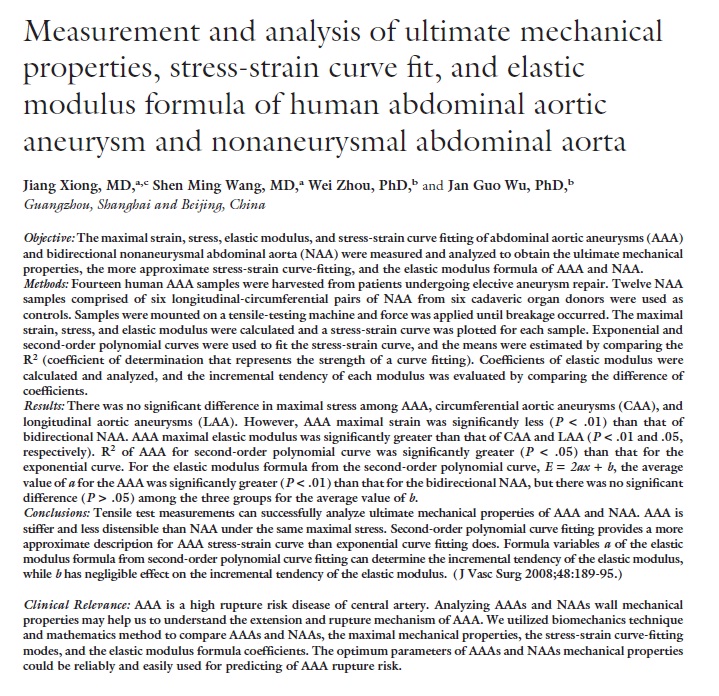
The maximal strain, stress, elastic modulus, and stress-strain curve fitting of abdominal aortic aneurysms (AAA) and bidirectional nonaneurysmal abdominal aorta (NAA) were measured and analyzed to obtain the ultimate mechanical properties, the more approximate stress-strain curve-fitting, and the elastic modulus formula of AAA and NAA.
Methods
Fourteen human AAA samples were harvested from patients undergoing elective aneurysm repair. Twelve NAA samples comprised of six longitudinal-circumferential pairs of NAA from six cadaveric organ donors were used as controls. Samples were mounted on a tensile-testing machine and force was applied until breakage occurred. The maximal strain, stress, and elastic modulus were calculated and a stress-strain curve was plotted for each sample. Exponential and second-order polynomial curves were used to fit the stress-strain curve, and the means were estimated by comparing the R2 (coefficient of determination that represents the strength of a curve fitting). Coefficients of elastic modulus were calculated and analyzed, and the incremental tendency of each modulus was evaluated by comparing the difference of coefficients.
Results
There was no significant difference in maximal stress among AAA, circumferential aortic aneurysms (CAA), and longitudinal aortic aneurysms (LAA). However, AAA maximal strain was significantly less (P < .01) than that of bidirectional NAA. AAA maximal elastic modulus was significantly greater than that of CAA and LAA (P < .01 and .05, respectively). R2 of AAA for second-order polynomial curve was significantly greater (P < .05) than that for the exponential curve. For the elastic modulus formula from the second-order polynomial curve, E = 2ax + b, the average value of a for the AAA was significantly greater (P < .01) than that for the bidirectional NAA, but there was no significant difference (P > .05) among the three groups for the average value of b.
Conclusions
Tensile test measurements can successfully analyze ultimate mechanical properties of AAA and NAA. AAA is stiffer and less distensible than NAA under the same maximal stress. Second-order polynomial curve fitting provides a more approximate description for AAA stress-strain curve than exponential curve fitting does. Formula variables a of the elastic modulus formula from second-order polynomial curve fitting can determine the incremental tendency of the elastic modulus, while b has negligible effect on the incremental tendency of the elastic modulus.