ترجمه روان شناسی و علوم تربیتی - 6 صفحه
سال 2012
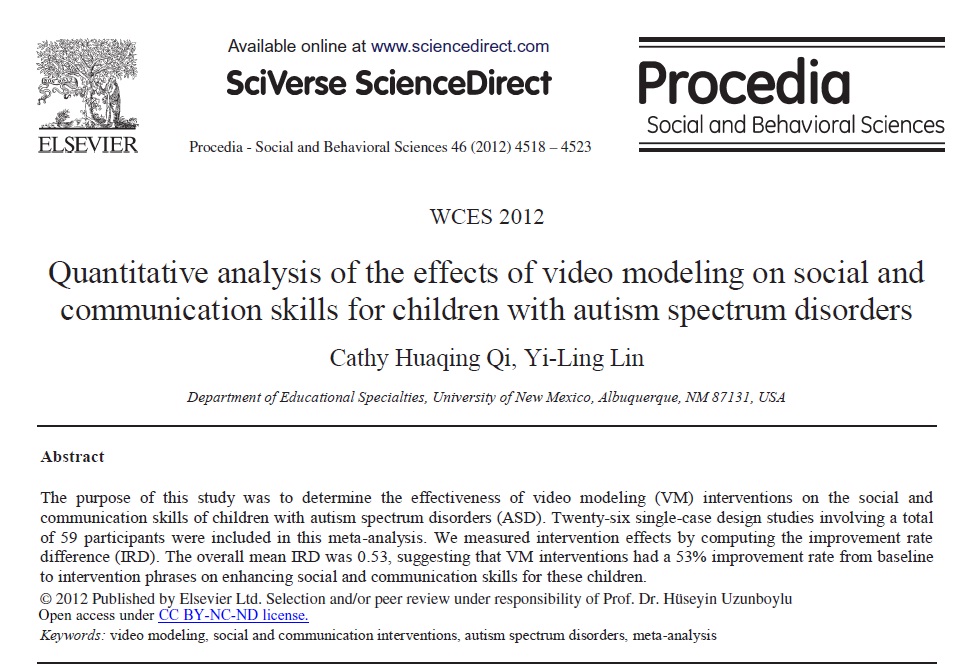
Quantitative Analysis of the Effects of Video Modeling on Social and Communication Skills
آنالیز کمی تاثیرات الگوبرداری ویدئویی بر روی مهارتهای اجتماعی و ارتباطی کودکانی
Cathy Huaqing Qi- Yi-Ling Lin
کتی هوا کنیگ کی، بی لینگ لین
بخش متخصصین در امور تحصیلی،دانشگاه نیومکزیکو، آلباکروک،ایالات متحده آمریکا
http://dx.doi.org/10.1016/j.sbspro.2012.06.288
دانلود رایگان مقاله انگلیسی - مهارتهای اجتماعی و ارتباطی کودکانی
چکیده
هدف از ارائه این مطالعه تحقیقی آن است که تاثیر مداخلات درمانی الگوبرداری ویدئو (vm) بر روی مهارتهای اجتماعی ومهارتهای ارتباطی کودکانی که از اختلالات گستره (طیف) اوتیسم (ASD) رنج می برند مشخص شود تحقیقات مبتنی بر 26 مورد طرح واحد26 نفر از شرکت کننده تان در ین نوع آنالیز متا درگیر ساخت. ما تاثیرات درمان مداخله جویانه بامحاسبه نسبت تفاوت سرعت بهبود مورد سنجش قرار دادیم (IRD) میانگین کلی نتایج IRD که در حدود 53% بود پیشنهاد می کرد که مداخلات درمانی vm (الگوبرداری ویدئویی) داری یک نسبت سرعت پیشرفت 53 درصدی از خط مبدا تا مراحل درمانی برای مهارتهای اجتماعی و مهارتهای ارتباطی این نوع کودکان بود. این مقاله در سال 2012 توسط انتشارات السویر به چاپ رسیده است و یا بررسی و انتخاب دقیق این مقاله تحت سرپرستی دکتر حسین اوزوبوبلو انجام شده است.
کلید واژه ها: الگو برداری ویدئویی، مداخلات درمانی ارتباطی و اجتماعی.
Abstract
The purpose of this study was to determine the effectiveness of video modeling (VM) interventions on the social and communication skills of children with autism spectrum disorders (ASD). Twenty-six single-case design studies involving a total of 59 participants were included in this meta-analysis. We measured intervention effects by computing the improvement rate difference (IRD). The overall mean IRD was 0.53, suggesting that VM interventions had a 53% improvement rate from baseline to intervention phrases on enhancing social and communication skills for these children.
Keywords
video modeling; social and communication interventions; autism spectrum disorders; meta-analysis
References
American Psychiatric Association., (2000). Diagnostic and statistical manual of mental disorders (4th ed.). Washington, DC: American Psychiatric Association.
*Apple, A.L., Billingsley, F., & Schwartz, I.S. (2005). Effects of video modeling alone and with self management on compliment-giving behavior of children with high-functioning ASD. Journal of Positive Behavior Interventions, 7(1), 33-46.
Ayres, K.M., & Langone, J. (2005). Intervention and instruction with video for students with autism: A review of the literature. Education and Training in Developmental Disabilities, 40(2), 183-196.
Bellini, S., & Akullian, J. (2007). A meta-analysis of video modeling and video self-modeling interventions for children and adolescents with autism spectrum disorder. Exceptional Children, 73(3), 264-287.
*Bellini, S., Akullian, J., & Hopf, A. (2007). Increasing social engagement in young children with Autism Spectrum Disorder using video self-modeling. School Psychology Review, 36(1), 80-90.
*Boudreau, E., & D’ Entremont, B. (2010). Improving the pretend play skills of preschoolers with Autism Spectrum Disorder: The effects of video modeling. Journal of Developmental and Physical Disabilities, 22, 415-431.
*Buggey, T. (2005). Video self-modeling applications with students with autism spectrum disorder in a small private school setting. Focus On Autism And Other Developmental Disabilities, 20(1), 52-63.
*Buggey, T., Hoomes, G., Sherberger, M.E., & Williams, S. (2011). Facilitating social initiations of preschoolers with autism spectrum disorders using video self-modeling. Focus on Autism and Other Developmental Disabilities, 26(1), 25-36.
*Buggey, T., Toombs, K., Gardener, P., & Cervetti, M. (1999). Training responding behaviors in students with autism: Using videotaped self-modeling. Journal of Positive Behavior Interventions, 1(4), 205-214.
*Cardon, T.A., & Wilcox, M.J. (2011). Promoting imitation in young children with autism: A comparison of reciprocal imitation training and 5 video modeling. Journal of Autism Developmental Disorders, 41, 654-666.
*Charlop, M.H., Dennis, B., Carpenter, M.H., & Greenberg, A.L. (2010). Teaching socially expressive behaviors to children with autism through video modeling. Education & Treatment of Children, 33(3), 371-393.
*D’Ateno, P., Mangiapanello, K., & Taylor, B.A. (2003). Using video modeling to teach complex play sequences to a preschooler with autism. Journal of Positive Behavior Interventions, 5(1), 5-11.
Delano, M.E. (2007). Video modeling intervention for individuals with autism. Remedial and Special Education, 28(1), 33-42.
Erion, J. (2006). Parent tutoring: A meta-analysis. Education and Treatment of Children, 26, 79-106.
*Gena, A., Couloura,S., & Kymissis, E. (2005). Modifying the affective behavior of preschoolers with Autism using in-vivo or video modeling and reinforcement contingencies. Journal of Autism and Developmental Disorder, 35(5), 545-556.
*Hine, J., & Wolery, M. (2006). Using point-of-view video modeling to teach play to preschoolers with Autism. Topics in Early Childhood Special Education, 26(2), 83-93.
Kazdin, (1978). History of behavior modification: Experimental foundations of contemporary research. Baltimore, MD: University Park Press.
*Kleeberger, V., & Mirenda, P. (2010). Teaching generalized imitation skills to a preschooler with autism using video modeling. Journal of Positive Behavior Interventions, 12(20), 116-127.
*LeBlanc, L.A., Coates, A.M., Daneshvar, S., Charlop-Christy, M.H., Morris, C., & Lancaster, B.M. (2003). Using video modeling and reinforcement to teach perspective-taking skills to children with autism. Journal of Applied Behavior Analysis, 36(2), 253-257.
Ma, H.H. (2006). An alternative method for quantitative synthesis of single subject research: Percentage of data point exceeding the median. Behavior Modification, 30, 598-617.
*MacDonald, R., Clark, M., Garrigan, E., & Vangala, M. (2005). Using video modeling to teach pretend play to children with Autism. Behavioral Interventions, 20, 225-238.
*Maione, L., & Mirenda, P. (2006). Effects of video modeling and video feedback on peer-directed social language skills of a child with autism. Journal of Positive Behavior Interventions, 8(2), 106-118.
*Marzullo-Kerth, D., Reeve, S.A., Reeve, K.F., & Townsend, D.B. (2011). Using multiple-exemplar training to teach a generalized repertoire of sharing to children with autism. Journal of Applied Behavior Analysis, 44(2), 279-294.
McCoy, K., & Hermansen, E. (2007). Video modeling for individuals with autism: A review of model types and effects. Education and Treatment of Children, 30(4), 183-213.
*Nikopoulos, C.K., & Keenan, M. (2007). Using video modeling to teach complex social sequences to children with autism. Journal of Autism and Developmental Disorders, 37(4), 678-693.
*Palechka, G., & MacDonald, R. (2010). A comparison of the acquisition of play skills using instructor-created video models and commercially available videos. Education & Treatment of Children, 33(3), 457-474.
Parker, R., & Hagan-Burke, S. (2007). Median-based overlap analysis for single case data. A second study. Behavior Modification, 31, 919-936.
Parker, R.I., & Vannest, K.J. (2009). An improved effect size for single case research: Nonoverlap of all pairs (NAP). Behavior Therapy, 40, 357-367.
Parker, R.I., Vannest, K.J., & Brown, L. (2009). The improvement rate difference for single case research. Exceptional Children, 75(2), 135-150.
*Sansosti, F.J., & Powell-Smith, K.A. (2008). Using computer-presented social stories and video models to increase the social communication skills of children with high-functioning autism spectrum disorders. Journal of Positive Behavior Interventions, 10(3), 162-178.
Scruggs, T.E., Mastropieri, M.A., & Casto, G. (1987). The quantitative synthesis of single subject research: Methodology a nd validation. Remedial and Special Education, 8, 24-32.
*Sherer, M., Pierce, K.L., Paredes, S., Kisacky, K.L., Ingersoll, B., & Schreibman, L. (2001). Enhancing conversation skills in children with autism via video technology: Which is better, “self” or “other” as a model? Behavior Modification, 25(1), 140-158.
*Simpson, A., Langone, J., & Ayres, K.M. (2004). Embedded video and computer based instruction to improve social skills for students with autism. Education & Training in Developmental Disabilities, 39(3), 240-252.
Shukla-Mehta, S., Miller, T., & Callahan, K.J. (2010). Evaluating the effectiveness of video instruction on social and communication skills training for children with autism spectrum disorders: A review of the literature. Focus on Autism and Other Developmental Disabilities, 25(1), 23-26.
*Taylor, B.A., Levin, L., & Jasper, S. (1999). Increasing play-related statements in children with autism toward their siblings: Effects of video modeling. Journal of Developmental and Physical Disabilities, 11(3), 253-264.
*Tetreault, A.S., & Lerman, D.C. (2010). Teaching social skills to children with autism using point-of-view video modeling. Education and Treatment of Children, 33(3), 395-419.
*Thiemann, K.S., & Goldstein, H. (2001). Social stories, written text cues, and video feedback: Effects on social communication of children with autism. Journal of Applied Behavior Analysis, 34(4), 425-446.
van den Noortgate, W., & Onghena, P. (2003). Combining single-case experimental data using hierarchical linear models. School Psychology Quarterly, 18, 325-346.
*Victor, H., Little, S.G., & Akin-Little, A. (2011). Increasing social engaged time in children with autism spectrum disorders using video self-modeling. Journal of Evidence-Based Practices for Schools, 12(1), 105-124.
Wang, S., Cui, Y., & Parrila, R. (2011). Examining the effectiveness of peer-mediated and video-modeling social skills interventions for children with autism spectrum disorders: A meta-analysis in single-case research using HLM. Research in Autism Spectrum Disorders, 5(1), 562-569.
*Wert, B.Y., & Neisworth, J.T. (2003). Effects of video self-modeling on spontaneous requesting in children with autism. Journal of Positive Behavior Interventions, 5(1), 30-34.