ترجمه حسابداری - 19 صفحه
Different Pre-Processing Models for Financial Accounts when Using Neural Networks for Auditing
مدلهای پیش پردازش مختلف برای حسابهای مالی زمانیکه از شبکه های عصبی برای حسابرسی استفاده می شود
Eija Koskivaara, Different Pre-processing Models for Financial Accounts when Using Neural Networks for Auditing
سال 2000
http://aisel.aisnet.org/ecis2000/3/
دانلود رایگان مقاله انگلیسی - شبکه های عصبی برای حسابرسی
چکیده
هدف از این تحقیق بررسی مدلهای مختلف پیش پردازش به روی قابلیت پیش بینی شبکه عصبی ساختگی است ANN زمانیکه حسابهای مالی، حسابرسی می شوند. بنابراین تمرکز این تحقیق به روی پیش پردازش داده هاست. ANN برای اهداف حسابرسی انتخاب شده زیرا آنها قابلیت یادگیری پیچیده و روابط غیرخطی اساسی را دارند. بنابراین آنها برای مدلسازی دینامیک و روابط بین ارزش حسابها به منظور یافتن نوسانات غیرمترقبه به کار می روند. این تحقیق، یک شبکه عصبی چندلایه با الگوریتم پس انتشار را به کار می برد. مدل شبکه عصبی ساختگی به کار رفته در این بررسی با استفاده از صورتهای مالی 31 شرکت تولیدی در طول بیش از 4 سال ساخته شده است. ارزش حسابها به عنوان یک سری زمان در نظر گرفته شده است. داده ها در چهار روش مختلف پیش پردازش شده اند. اولاً تمامی داده ها به صورت خطی انتخاب شده اند. ثانیاً داده ها به صورت سالانه و به صورت خطی پیش پردازش شده اند. ثالثاً داده هایی که به صورت خطی پیش پردازش شده اند براساس شرکت های خاص می باشند. و چهارم اینکه داده ها براساس شرکت و سالانه پیش پردازش می شوند. بهترین نتیجه زمانی به دست می آید که تمامی داده ها به صورت خطی یا خطی و به صورت سالانه انتخاب شده باشند.
Abstract
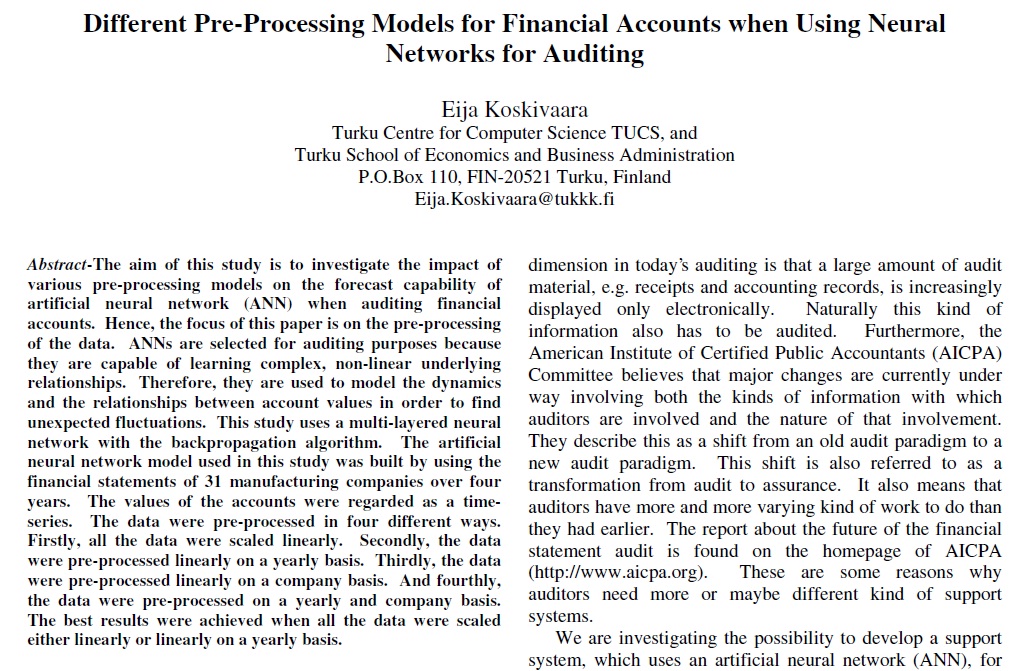
The aim of this study is to investigate the impact of various pre-processing models on the forecast capability of artificial neural network (ANN) when auditing financial accounts. Hence, the focus of this paper is on the pre-processing of the data. ANNs are selected for auditing purposes because they are capable of learning complex, non-linear underlying relationships. Therefore, they are used to model the dynamics and the relationships between account values in order to find unexpected fluctuations. This study uses a multi-layered neural network with the backpropagation algorithm. The artificial neural network model used in this study was built by using the financial statements of 31 manufacturing companies over four years. The values of the accounts were regarded as a timeseries. The data were pre-processed in four different ways. Firstly, all the data were scaled linearly. Secondly, the data were pre-processed linearly on a yearly basis. Thirdly, the data were pre-processed linearly on a company basis. And fourthly, the data were pre-processed on a yearly and company basis. The best results were achieved when all the data were scaled either linearly or linearly on a yearly basis.