ترجمه حسابداری-19 صفحه
اولویتهای منفی در فرایند تحلیل سلسه مراتبی
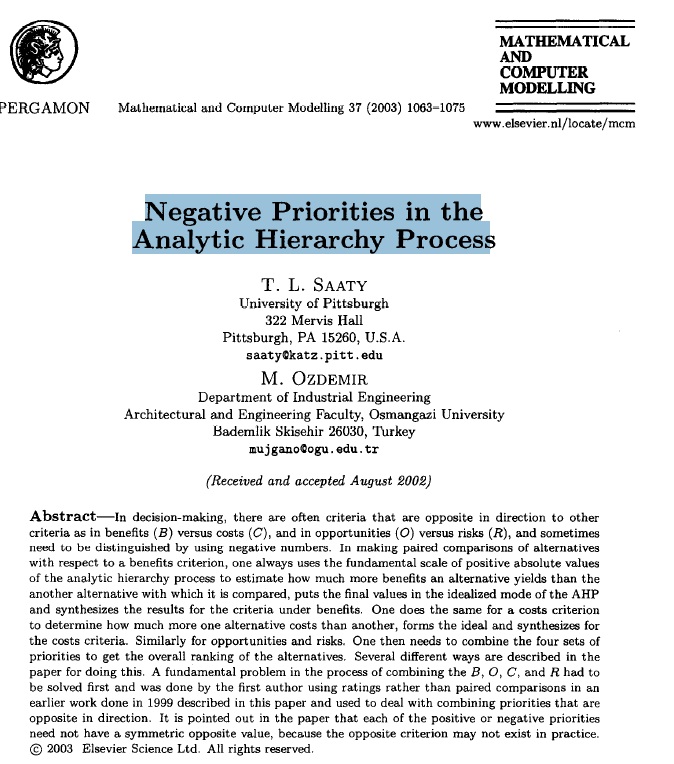
Negative Priorities in the Analytic Hierarchy Process
سال 2003
http://dx.doi.org/10.1016/S0895-7177(03)00118-3
T.L. Saaty
دانلود رایگان مقاله انگلیسی - تحلیل سلسله مراتبی
چکیده
در تصمیم گیری اغلب معیارهایی وجود دارد که در تضاد با معیارهای دیگر می باشند، مثلا مزایا در برابر هزینه ها و فرصتها در برابر ریسکها قرار دارند، و گاهی اوقات لازم است که این معیارها را با استفاده از اعداد منفی (معکوس) تمیز داد. AHP در مقایسات زوجی گزینه ها، نسبت به معیار مزایا (benefits) برای برآورد اینکه یک گزینه نسبت به گزینه دیگر که با آن مقایسه میشود چه مقدار مزایای بیشتری دارد همواره از مقادیر مثبت استفاده می کند. AHP در روش ایده آل مقادیر نهایی را قرار داده و نتایج آن را برای معیارهای مزایا ترکیب میکند. همین شیوه را می توان برای معیار هزینه ها انجام داد. برای اینکه تعیین کنیم هزینه های یک گزینه چه مقدار بیشتر از گزینه دیگر است، حالت ایده آل آن را تشکیل داده و آن را برای معیارهای هزینه ترکیب کنید. این کار را بطور مشابه برای فرصتها و ریسکها نیز می توان انجام داد. بنابراین نیاز است تا چهار مجموعه اولویت بندی را برای رتبه بندی کلی گزینه ها ترکیب کنیم. در این مقاله چندین شیوه متفاوت برای انجام این کار ارائه گردیده است. ابتدا باید مشکل اصلی در فرآیندترکیبB, R, O. C (مزایا، هزینه ها، فرصتهاو ریسکها) حل شود، که این کار پیش از این در مقاله ای دیگر در سال 1999 بوسیله نویسنده اول با استفاده از رتبه بندی بجای مقایسات زوجی انجام شده است که در این مقاله توصیف شده و برای برخورد با ترکیب اولویتهایی که در جهت مخالف هستند استفاده شده است. در این مقاله اشاره شده است که هر اولویت بندی مثبت و منفی نیاز به مقدار متقابل متناسب ندارد، بخاطر اینکه مقدار متقابل ممکن است در عمل وجود نداشته باشد.
کلمات کلیدی : فرایند تحلیل سلسه مراتبی، مزایا - هزینه ها - فرصتها - ریسکها (BOCR)، تصمیم گیری اولویت های منفی
Abstract
In decision-making, there are often criteria that are opposite in direction to other criteria as in benefits (B) versus costs (C), and in opportunities (O) versus risks (R), and sometimes need to be distinguished by using negative numbers. In making paired comparisons of alternatives with respect to a benefits criterion, one always uses the fundamental scale of positive absolute values of the analytic hierarchy process to estimate how much more benefits an alternative yields than the another alternative with which it is compared, puts the final values in the idealized mode of the AHP and synthesizes the results for the criteria under benefits. One does the same for a costs criterion to determine how much more one alternative costs than another, forms the ideal and synthesizes for the costs criteria. Similarly for opportunities and risks. One then needs to combine the four sets of priorities to get the overall ranking of the alternatives. Several different ways are described in the paper for doing this. A fundamental problem in the process of combining the B, O, C, and R had to be solved first and was done by the first author using ratings rather than paired comparisons in an earlier work done in 1999 described in this paper and used to deal with combining priorities that are opposite in direction. It is pointed out in the paper that each of the positive or negative priorities need not have a symmetric opposite value, because the opposite criterion may not exist in practice.
Keywords
Analytic hierarchy process; Benefits-costs-opportunities-risks; Decision making; Negative priorities
References
T.L. SaatyFundamentals of Decision Making and Priority Theory with the Analytic Hierarchy ProcessRWS, Pittsburgh, PA (2000)
W.F. Lucas, F.S. Roberts, R.M. ThrallModules in Applied Mathematics, Volume 3, Springer-Verlag, New York (1983)
T.L. Saaty, P.C. RogersHigher education in the United States (1985–2000): Scenario construction using a hierarchical framework with eigenvector weightingSocio-Eton. Planning Sciences, 10 (1976), pp. 251-264
T.L. SaatyDecision Making with Dependence and FeedbackThe Analytic Network Process, RWS, Pittsburgh, PA (1996)
P. Korhonen, H. TopdagiPeformance of the AHP in comparison of gains and lossesHelsinki School of Economics (2002) unpublished
M. KlineMathematics in Western CultureOxford University Press, New York (1953)
J.L. BerggrenEpisodes in the Mathematics of Medieval IslamSpringer-Verlag, New York (1986)
Great Soviet Encyclopedia, MacMillan, New York (1979)
D.J. Struik, A Concise History of Mathematics, Volume I, II.
M. KlineMathematical Thought from Ancient to Modern Times, Volumes 1,2,3, Oxford University Press, New York (1972)
C.L. BoyerA History of MathematicsPrinceton University Press, New Jersey (1985)
T.L. Saaty, Y. ChoThe decision by the U.S. Congress on China's trade status: A multicriteria analysisSocio-Economic Planning Sciences, 35 (2001), pp. 243-252