ترجمه کامپیوتر -29 صفحه
یادگیری ماشین - مبنی بر نمونـه
Machine Learning
http://www.cs.cmu.edu/~tom
دانلود رایگان مقاله انگلیسی -یادگیری ماشین
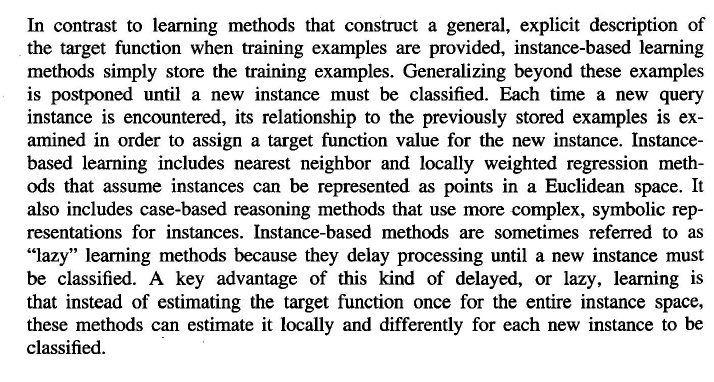
در مقایسه با روش های یادگیری كه یك توضیح صریح و كلی از هدف كار هنگام ارائه نمونه های آموزشی، فراهم می كنند. روش های مبنی بر نمونه به سادگی نمونه های آموزشی را ذخیره می كنند. عمومیت دادن در ورای این نمونه ها تا زمانی كه یك نمونه جدید طبقه بندی گردد، به تعویق می افتد. هر زمان كه با یك نمونه جدید پرسش و پاسخ مواجه می شود، رابطه اش با نمونه های ذخیره شده ی قبلی برای تعیین ارزش یك عمل هدفمند برای نمونه جدید محاسبه می گردد. یادگیری مبنی بر نمونه، روش های نزدیك ترین مجاور و رگرسیون وزن دار محلی را در بر می گیرد كه نمونه هایی را می توانند به صورت نقاطی در فضای «Euelideam» قرار گیرند را فرض می كند. آن روش های استدلال مبنی بر نمونه بعضی اوقات به صورت روش های یادگیری «كُند» اشاره دارد، زیرا آن ها بررسی را تا زمانی كه یك نمونه جدید طبقه بندی شود، به تأخیر می اندازند. یك امتیاز مهم این نوع یادگیری تأخیر یا كُند این است كه به جای یكبار محاسبه كردن عمل هدفمند برای كل فضای نمونه، این روش ها می توانند آن را، در محل و به طور متفاوت برای هر نمونه جدید كه طبقه بندی می شود، محاسبه نمایند.
Instance-based learning
In machine learning, instance-based learning (sometimes called memory-based learning[1]) is a family of learning algorithms that, instead of performing explicit generalization, compares new problem instances with instances seen in training, which have been stored in memory.
It is called instance-based because it constructs hypotheses directly from the training instances themselves.[2] This means that the hypothesis complexity can grow with the data:[2] in the worst case, a hypothesis is a list of n training items and the computational complexity of classifying a single new instance is O(n). One advantage that instance-based learning has over other methods of machine learning is its ability to adapt its model to previously unseen data. Instance-based learners may simply store a new instance or throw an old instance away.
Examples of instance-based learning algorithm are the k-nearest neighbor algorithm, kernel machines and RBF networks.[3]:ch. 8 These store (a subset of) their training set; when predicting a value/class for a new instance, they compute distances or similarities between this instance and the training instances to make a decision.
To battle the memory complexity of storing all training instances, as well as the risk of overfitting to noise in the training set, instance reduction algorithms have been proposed.[4]
Gagliardi[5] applies this family of classifiers in medical field as second-opinion diagnostic tools and as tools for the knowledge extraction phase in the process of knowledge discovery in databases. One of these classifiers (called Prototype exemplar learning classifier (PEL-C) is able to extract a mixture of abstracted prototypical cases (that are syndromes) and selected atypical clinical cases.