ترجمه معماری-17 صفحه
سال 2012
Green occupants for green buildings-The missing link
ساکنین سبز برای ساختمان های سبز
Max Paul Deuble a,*, Richard John de Dear b
a Department of Environment and Geography, Faculty of Science, Macquarie University, Sydney, NSW 2109, Australia
b Faculty of Architecture, Design and Planning, The University of Sydney, Sydney, NSW 2006, Australia
دانلود رایگان مقاله انگلیسی-ساکنین سبز برای ساختمان های سبز
چکیده
ساختمان سبز که اغلب به عنوان ساختمان های با قابلیت تهویه طبیعی، یعنی ساختمان های با انرژی پایین یا فعال آزاد، تعریف می شوند حالا طلایه دار تحقیق ساختمانی و سناریوهای کاهش تغییر اقلیم هستند. این مقاله نتایج پیمایش های ارزشیابی بعد از سکونت (POE) اخیر در دو ساختمان اداری آکادمیک را دنبال می کند که در منطقه نیمه استوایی سیدنی، استرالیا، واقع شده اند. با توجه به پرسشنامه گرایش های زیست محیطی براساس نمونه اکولوژیکی جدید مشخص شد که سطح رضایت سکنه در POE رابطه مثبتی با باورهای زیست محیطی داشت. سکنه با سطح بالاتر نگرانی زیست محیطی درباره ساختمان های خود بخشنده تر بودند، مخصوصا در رابطه با جنبه های طراحی سبز مثل تهویه طبیعی از طریق پنجره های دایر این حس را داشتند. علیرغم انتقادات کیفیت زیست محیطی داخلی ساختمان، سکنه 'سبز' بیشتر از همتاهای 'قهوه ای' (غیر سبز) خود برای نادیده گرفتن و بخشش شرایط کمتر از ایده آل آمادگی داشتند. این نتایج فرضیه ای که گرایش های طرفدار محیط زیست رابطه نزدیکی با 'فاکتور بخشندگی' قوی تر مشاهده شده در ساختمان های سبز را پشتیبانی می کند اما سوال علیت باقی می ماند.
کلمات کلیدی: ساختمان های سبز، ارزشیابی بعد از سکونت (POE)، فاکتور بخشندگی، نمونه اکولوژیکی جدید (NEP)
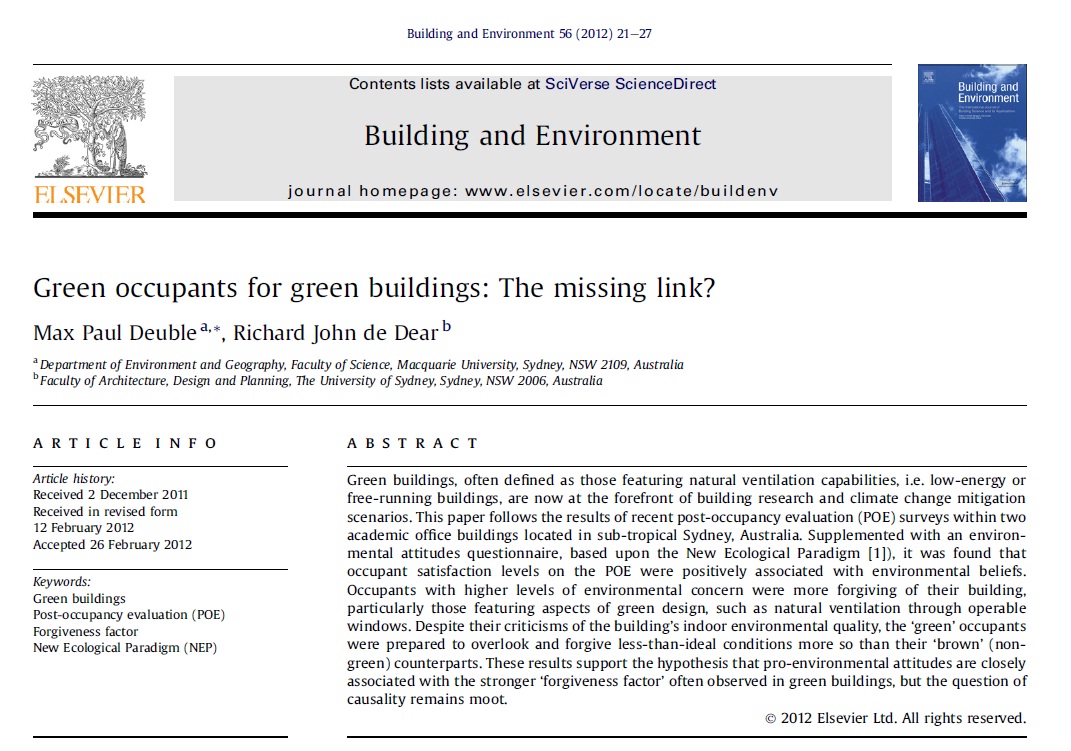
Abstract
Green buildings, often defined as those featuring natural ventilation capabilities, i.e. low-energy or free-running buildings, are now at the forefront of building research and climate change mitigation scenarios. This paper follows the results of recent post-occupancy evaluation (POE) surveys within two academic office buildings located in sub-tropical Sydney, Australia. Supplemented with an environmental attitudes questionnaire, based upon the New Ecological Paradigm [1]), it was found that occupant satisfaction levels on the POE were positively associated with environmental beliefs. Occupants with higher levels of environmental concern were more forgiving of their building, particularly those featuring aspects of green design, such as natural ventilation through operable windows. Despite their criticisms of the building’s indoor environmental quality, the ‘green’ occupants were prepared to overlook and forgive less-than-ideal conditions more so than their ‘brown’ (non-green) counterparts. These results support the hypothesis that pro-environmental attitudes are closely associated with the stronger ‘forgiveness factor’ often observed in green buildings, but the question of causality remains moot.
Highlights
► Indoor temperatures were warmer in the naturally ventilated building.
► Occupants of the mixed-mode building had lower environmental attitudes.
► Forgiveness factors were significantly higher in the naturally ventilated building.
► Increased environmentalism associated with increased tolerance of green building.
Keywords
Green buildings; Post-occupancy evaluation (POE); Forgiveness factor; New Ecological Paradigm (NEP)
Recommended articles
A comparison of occupant comfort and satisfaction between a green building and a conventional building
2008, Building and Environment
Post occupancy evaluations relating to discomfort glare: A study of green buildings in Brisbane
2013, Building and Environment
Thermal comparison between ceiling diffusers and fabric ductwork diffusers for green buildings
2011, Energy and Buildings