ترجمه مدیریت و حسابداری -28 صفحه
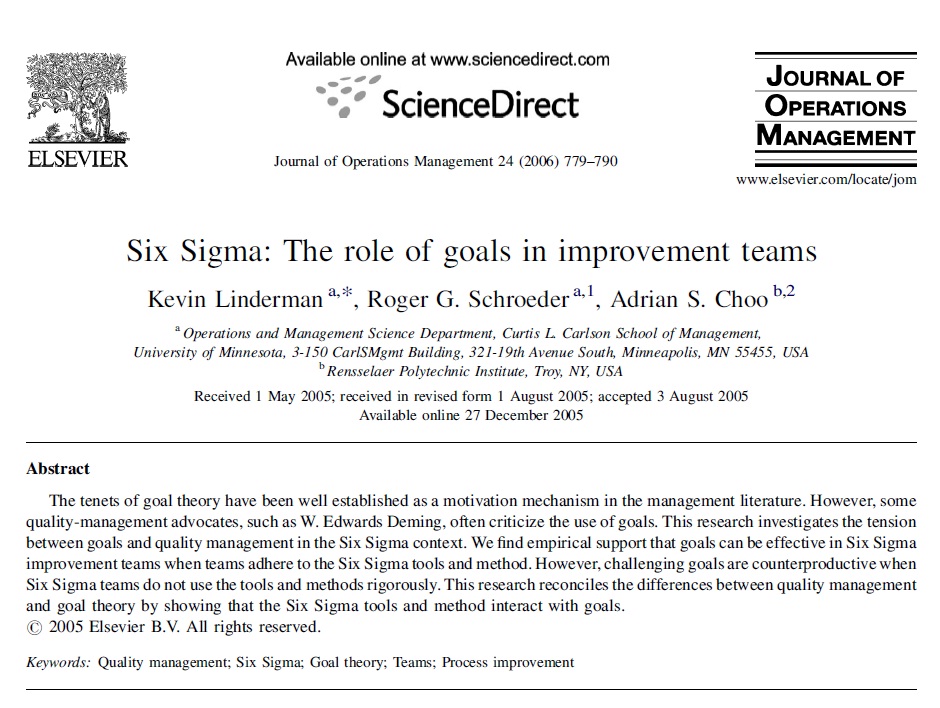
Six Sigma: The role of goals in improvement teams
شش سیگما-نقش اهداف در تیم های بهبود
Kevin Linderman a,*, Roger G. Schroeder a,1, Adrian S. Choo b,2
a Operations and Management Science Department, Curtis L. Carlson School of Management,
University of Minnesota, 3-150 CarlSMgmt Building, 321-19th Avenue South, Minneapolis, MN 55455, USA
b Rensselaer Polytechnic Institute, Troy, NY, USA
http://www.sciencedirect.com/science/article/pii/S0272696305001592
دانلود رایگان مقاله انگلیسی-شش سیگما-نقش اهداف
چکیده
اصول تئوری هدف به خوبی به عنوان یک مکانیسم انگیزشی در منابع مدیریتی تبیین شده اند. با این حال، برخی حامیان مدیریت کیفی، مثل دابلیو.ادواردز دمینگ، اغلب استفاده از اهداف را مورد انتقاد قرار می دهند. این تحقیق تنش بین اهداف و مدیریت کیفی در متن شش سیگما را بررسی می کند. پشتیبانی تجربی برای آن می یابیم که اهداف می توانند در تیم های بهبود شش سیگما موثر باشند زمانی که تیم ها به ابزار و روش شش سیگما وفادار باشند. با این حال، لغو اهداف زمانی ضد تولیدی هستند که تیم های شش سیگما از ابزار و روش های کامل استفاده ننمایند. این تحقیق توافق های بین مدیریت کیفی و تئوری هدف را با نمایش این امر مشخص می کند که ابزار و روش شش سیگما با اهداف تعامل دارند.
کلیدواژه ها: مدیریت کیفی؛ شش سیگما؛ تئوری هدف؛ تیم ها؛ بهبود فرایند
Abstract
The tenets of goal theory have been well established as a motivation mechanism in the management literature. However, some quality-management advocates, such as W. Edwards Deming, often criticize the use of goals. This research investigates the tension between goals and quality management in the Six Sigma context. We find empirical support that goals can be effective in Six Sigma improvement teams when teams adhere to the Six Sigma tools and method. However, challenging goals are counterproductive when Six Sigma teams do not use the tools and methods rigorously. This research reconciles the differences between quality management and goal theory by showing that the Six Sigma tools and method interact with goals.
Keywords
Quality management; Six Sigma; Goal theory; Teams; Process improvement
This article belongs to a special issue
Incorporationg Behavioral Theory in OM Empirical Models — AND
Edited By Elliot Bendoly, Markham T. Frohlich and J. Robb Dixon
Editorial
Kenneth K. Boyer, , Morgan Swink,
Incorporating behavioral theory in OM empirical models
Elliot Bendoly,
Behavior in operations management: Assessing recent findings and revisiting old assumptions
Elliot Bendoly, , Karen Donohue, , Kenneth L. Schu