ترجمه مدیریت - 37 صفحه
سال 2012
A Configuration Model of Organizational Culture
یک مدل ترکیبی از فرهنگ سازمانی
Daniel Dauber, Gerhard Fink, and Maurice Yolles
http://journals.sagepub.com/doi/abs/10.1177/2158244012441482
دانلود رایگان مقاله انگلیسی- فرهنگ سازمانی
چکیده:
این مقاله، یک مدل ترکیبی از فرهنگ سازمانی پیشنهاد می کند که ارتباطات فعال بین فرهنگ سازمانی، راهبردها، ساختار و عملکردهای یک سازمان (محیط داخلی) و تعاملات با محیط خارجی (محیط انجام وظایف) را کشف نماید. ویژگی اصلی مدل ساختاری، این است که فرایندهای مشخصی دارد که اجزای مدل را به صورت منظم به یکدیگر مرتبط می سازد، از جمله قوس های یادگیری منفرد و مضاعف، عملکردی کردن راهبردها، مدیریت قانونی و غیره. این مدل در زمینه یک مقاله مروری وسیع در حوزه های تحقیقاتی مختلف واقع شده و مدل های شناخته شده ای را در حوزه سازمان و نظریه فرهنگ، شکل می دهد. همچنین دارای پاسخی به درخواست مدل های جدید می باشد، که می توانند بررسی پیچیدگی عملکردی که سازمان امروزه با آن رو به رو است را تشریح نمایند. مدل ترکیبی فرهنگ سازمانی، مورد توجه بسیاری از محققینی قرار گرفته که در مورد پدیده های فرهنگی و تغییرات آن ها در طول زمان تحقیق می کنند.
کلیدواژه ها:فرهنگ سازمانی، راهبرد، ساختار، یادگیری سازمانی، فرایندهای سازمانی.
Abstract
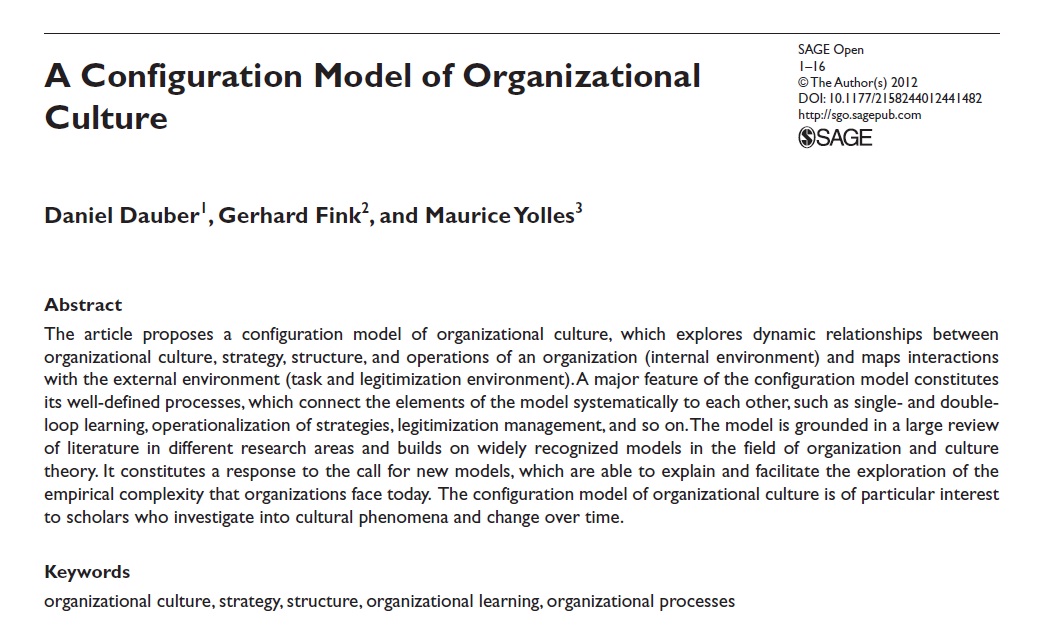
The article proposes a configuration model of organizational culture, which explores dynamic relationships between organizational culture, strategy, structure, and operations of an organization (internal environment) and maps interactions with the external environment (task and legitimization environment). A major feature of the configuration model constitutes its well-defined processes, which connect the elements of the model systematically to each other, such as single- and double-loop learning, operationalization of strategies, legitimization management, and so on. The model is grounded in a large review of literature in different research areas and builds on widely recognized models in the field of organization and culture theory. It constitutes a response to the call for new models, which are able to explain and facilitate the exploration of the empirical complexity that organizations face today. The configuration model of organizational culture is of particular interest to scholars who investigate into cultural phenomena and change over time.
References
Aldrich H. E., Pfeffer J. (1976). Environments of organizations. Annual Review of Sociology, 2, 79-105. Google Scholar
Allaire Y., Firsirotu M. E. (1984). Theories of organizational culture. Organization Studies, 5, 193-226. Google Scholar Abstract
Alvesson M. (2002). Understanding organizational culture. London, England: SAGE. Google Scholar
Amburgey T. L., Dacin T. (1994). As the left foot follows the right? The dynamics of strategic and structural change. Academy of Management Journal, 37, 1427-1452. Google Scholar
Andrews K. (1971). The concept of corporate strategy. Homewood, IL: Dow Jones-Irwin. Google Scholar
Ansoff H. I. (1965). Corporate strategy: An analytic approach to business policy for growth and expansion. New York, NY: McGraw-Hill. Google Scholar
Argyris C. (1977, September-October). Double loop learning in organizations. Harvard Business Review, 115-125. Google Scholar
Argyris C., Schön D. (1978). Organizational learning: A theory of action perspective. Reading, MA: Addison-Wesley. Google Scholar
Barney J. (1986). Organizational culture: Can it be a source of competitive advantage? Academy of Management Review, 3, 656-665. Google Scholar
Barney J. (1991). Firm resources and sustained competitive advantage. Journal of Management, 17, 99-120. Google Scholar Link
Beer M., Eisenstat R. A. (2000). The silent killers of strategy implementation and learning. Sloan Management Review, 41, 29-40. Google Scholar
Beer S. (1989). The viable system model: Its provenance, development, methodology and pathology. Journal of Operational Research Society, 35, 7-26. Google Scholar
Berry J. W. (1980). Acculturation as varieties of adaptation. In Padilla A. (Ed.), Acculturation, theory, models and some new findings (pp. 9-25). Boulder, CO: Westview Press. Google Scholar
Björkman I., Stahl G. K., Vaara E. (2007). Cultural differences and capability transfer in cross-border acquisitions: The mediating roles of capability complementarity, absorptive capacity, and social integration. Journal of International Business Studies, 38, 658-672. Google Scholar CrossRef
Burgelman R. A., McKinney W. (2006). Managing the strategic dynamics of acquisition integration: Lessons from HP and Compaq. California Management Review, 48(3), 6-27. Google Scholar Abstract
Cameron K. S., Quinn R. E. (2005). Diagnosing and changing organizational culture: Based on the competing values framework. San Francisco, CA: Jossey-Bass. Google Scholar
Cartwright S., Cooper C. L. (1993). The role of culture compatibility in successful organizational marriage. Academy of Management Executive, 7, 57-70. Google Scholar
Caves R. E. (1980). Industrial organization, corporate strategy, and structure. Journal of Economic Literature, 18, 64-92. Google Scholar
Chandler A. D. (1962). Strategy and structure. Cambridge, MA: MIT Press. Google Scholar
Chatterjee S., Lubatkin M. H., Schweiger D. M., Weber Y. (1992). Cultural differences and shareholder value in related mergers: Linking equity and human capital. Strategic Management Journal, 13, 319-334. Google Scholar CrossRef
Chhokar J. S., Brodbeck F. C., House R. J. (2007). Culture and leadership across the world: The GLOBE book of in-depth studies of 25 societies. Mahwah, NJ: Lawrence Erlbaum. Google Scholar
Child J. (1972). Organizational structure, environment, and performance: The role of strategic choice. Sociology, 6(1), 1-22. Google Scholar Abstract
Daft R. L. (2009). Organization theory and design (p. 17). South-Western Pub. Google Scholar
Dauber D. (2011). Hybridization in mergers and acquisitions (Doctoral thesis). Vienna University of Economics and Business, Austria. Google Scholar
Dauber D., Fink G. (2009). Hybridization in social systems: A conceptual perspective. Annual Meeting of the International Association of Cross-Cultural Competence and Management (IACCM). Available at http://ssrn.com/abstract=1748365 Google Scholar
Denison D. R., Haaland S., Goelzer P. (2004). Corporate culture and organizational effectiveness: Is Asia different from the rest of the world? Organizational Dynamics, 33, 98-109. Google Scholar
DiMaggio P. J., Powell W. W. (1994). The new institutionalism in organizational analysis. Chicago, IL: University of Chicago Press. Google Scholar
Dodgson M. (1993). Organizational learning: A review of some literature. Organization Studies, 14, 375-394. Google Scholar Abstract
Donaldson L. (1987). Strategy and structural adjustment to regain fit and performance: In defense of contingency theory. Journal of Management Studies, 24, 1-24. Google Scholar
Donaldson L. (1996). For positive organization theory: Proving the hard core. London, England: SAGE. Google Scholar
Donnelly-Cox G., O’Regan A. (1999, March). Resourcing organisational growth and development: A typology of third sector service delivery organizations. Paper presented to IRSPMIII, Aston. Google Scholar
Dubin R. (1978). Theory development. New York, NY: Free Press. Google Scholar
Fink G., Mayrhofer W. (2009). Cross-cultural competence and management–setting the stage. European Journal of Cross-Cultural Competence and Management, 1, 42-65. Google Scholar
Fiol M., Lyles M. A. (1985). Organizational learning. Academy of Management Review, 10, 803-813. Google Scholar
Fredrickson J. W. (1986). The strategic decision process and organizational structure. Academy of Management Review, 11, 280-297. Google Scholar
Freeman R. E. (1984). Strategic management: A stakeholder approach. Boston, MA: Pitman/Ballinger. Google Scholar
Galbraith J. R., Nathanson D. A. (1978). Strategy implementation: The role of structure and process. St. Paul, MN: West. Google Scholar
Gartner W. B. (1985). A conceptual framework for describing the phenomenon of new venture creation. Academy of Management Review, 10, 696-706. Google Scholar
Gordon G. G., DiTomaso N. (1992). Predicting corporate performance from organizational culture. Journal of Management Studies, 29, 783-798. Google Scholar
Hall E. T. (1976). Beyond culture. New York, NY: Anchor Books. Google Scholar
Hamilton R. T., Shergill G. S. (1992). The relationship between strategy-structure fit and financial performance in New Zealand: Evidence of generality and validity with enhanced controls. Journal of Management Studies, 29, 95-113. Google Scholar
Hamilton R. T., Shergill G. S. (1993). The logic of New Zealand business: Strategy, structure, and performance, Auckland. New Zealand: Oxford University Press. Google Scholar
Handy C. B. (1993). Understanding organizations. New York, NY: Oxford University Press. Google Scholar
Harris I. C., Ruefli T. W. (2000). The strategy/structure debate: An examination of the performance implications. Journal of Management Studies, 37, 587-604. Google Scholar
Haspeslagh P. C., Jemison D. B. (1991). The challenge of renewal through acquisitions. Planning Review, 19, 27-32. Google Scholar
Hatch M. J. (1993). The dynamics of organizational culture. Academy of Management Review, 18, 657-693. Google Scholar
Hatch M. J., Cunliffe A. L. (2006). Organization theory. Oxford, UK: Oxford University Press. Google Scholar
Hofstede G. (1980). Culture’s consequences—International differences in work-related values. Newbury Park, CA: SAGE. Google Scholar
Hofstede G. (2001). Culture’s consequences: Comparing values, behaviors, institutions and organizations across nations. London, England: SAGE. Google Scholar
Hofstede G., Neuijen B., Ohayv D. D., Sanders G. (1990). Measuring organizational cultures: A qualitative and quantitative study across twenty cases. Administrative Science Quarterly, 35, 286-316. Google Scholar
Homburg C., Pflesser C. (2000). A multiple-layer model of market-oriented organizational culture: Measurement issues and performance outcomes. Journal of Marketing Research, 37, 449-462. Google Scholar CrossRef
House R. J., Hanges P. J., Javidan M., Dorfman P., Gupta V. (2004). Culture, leadership and organizations: The GLOBE study of 62 societies. Thousand Oaks, CA: SAGE. Google Scholar
Ilies R., Scott B. A., Judge T. A. (2006). The interactive effects of personal traits and experienced states on intra-individual patterns of citizenship behavior. Academy of Management Journal, 49, 561-575. Google Scholar
Kaplan A. (1964). The conduct of inquiry. San Francisco, CA: Chandler. Google Scholar
Marcoulides G. A., Heck R. H. (1993). Organizational culture and performance: Proposing and testing a model. Organization Science, 4, 209-225. Google Scholar
Maxwell S. E., Cole D. A. (2007). Bias in cross-sectional analyses of longitudinal mediation. Psychological Methods, 12, 23-44. Google Scholar CrossRef, Medline
Meyer A. D., Tsui A. S., Hinings C. R. (1993). Configurational approaches to organizational analysis. Academy of Management Journal, 36, 1175-1195. Google Scholar CrossRef
Meyer J. W., Rowan B. (1977). Institutionalized organizations: Formal structure as myth and ceremony. American Journal of Sociology, 83, 340-363. Google Scholar CrossRef
Mitchell T. R., James L. R. (2001). Building better theory: Time and the specification of when things happen. Academy of Management Review, 26, 530-547. Google Scholar
Parsons T. (1960). Structure and process in modern societies. Glencoe, IL: Free Press. Google Scholar
Ployhart R. E., Vandenberg R. J. (2010). Longitudinal research: The theory, design, and analysis of change. Journal of Management, 36, 94-120. Google Scholar Link
Porter M. E. (1980). Competitive strategy. New York, NY: Free Press. Google Scholar
Porter M. E. (1985). Competitive advantage. New York, NY: Free Press. Google Scholar
Puranam P., Srikanth K. (2007). What they know vs. what they do: How acquirers leverage technology acquisitions. Strategic Management Journal, 28, 805-825. Google Scholar CrossRef
Puranam P., Singh H., Chaudhuri S. R. (2009). Integrating acquired capabilities: When structural integration is (un)necessary. Organization Science, 20, 313-328. Google Scholar CrossRef
Puranam P., Singh H., Zollo M. (2006). Organizing for innovation: Managing the coordination-autonomy dilemma in technology acquisitions. Academy of Management Journal, 49, 263-280. Google Scholar CrossRef
Richard S. W. (1992). Organizations: Rational, natural, and open systems. Englewood Cliffs, NJ: Prentice Hall. Google Scholar
Sagiv L., Schwartz S. H. (2007). Cultural values in organisations: Insights for Europe. European Journal of International Management, 1, 176-190. Google Scholar
Schein E. H. (1985). Organizational culture and leadership. San Francisco, CA: Jossey-Bass. Google Scholar
Scott W. R. (2008). Institutions and organizations: Ideas and interests. Thousand Oaks, CA: SAGE. Google Scholar
Smith W. K., Lewis M. W. (2011). Toward a theory of paradox: A dynamic equilibrium model of organizing. Academy of Management Review, 36, 381-403. Google Scholar
Stahl G. K., Voigt A. (2008). Do cultural differences matter in mergers and acquisitions? A tentative model and examination. Organization Science, 19, 160-176. Google Scholar CrossRef
Stopford J. M., Wells L. T. (1972). Managing the multinational enterprise. New York, NY: Basic Books. Google Scholar
Suchman M. C. (1995). Managing legitimacy: Strategic and institutional approaches. Academy of Management Review, 20, 571-610. Google Scholar
Thompson J. D. (2003). Organizations in action: Social science bases of administrative theory. New Brunswick, NJ: Transaction Publishers. Google Scholar
Tsui A. S., Nifadkar S. S., Ou A. Y. (2007). Cross-national, cross-cultural organizational behavior research: Advances, gaps, and recommendations. Journal of Management, 33, 426-478. Google Scholar Link
Vancouver J. B., Thompson C. M., Williams A. A. (2001). The changing signs in the relationships between self-efficacy, personal goals, and performance. Journal of Applied Psychology, 86, 605-620. Google Scholar
Waldman D. A., Javidan M. (2009). Alternative forms of charismatic leadership in the integration of mergers and acquisitions. Leadership Quarterly, 20, 130-142. Google Scholar
Whetten D. A. (1989). What constitutes a theoretical contribution. Academy of Management Journal, 14, 490-495. Google Scholar
Whittington R. (2001). What is strategy—And does it matter? London, England: Routledge. Google Scholar
Wilkins A. L., Ouchi W. G. (1983). Efficient cultures: Exploring the relationship between culture and organizational performance. Administrative Science Quarterly, 28, 468-481. Google Scholar
Williamson O. E. (1975). Markets and hierarchies. New York, NY: Free Press. Google Scholar
Wolf J., Egelhoff W. G. (2002). A reexamination and extension of international strategy-structure theory. Strategic Management Journal, 23, 181-189. Google Scholar
Yolles M. I. (1999). Management systems: A viable approach. London, England: Financial Times Pitman. Google Scholar
Yolles M. I. (2006). Organisations as complex systems: An introduction to knowledge cybernetics. Greenwich, CT: Information Age Publishing. Google Scholar