ترجمه مدیریت - 30 صفحه
سال 2012
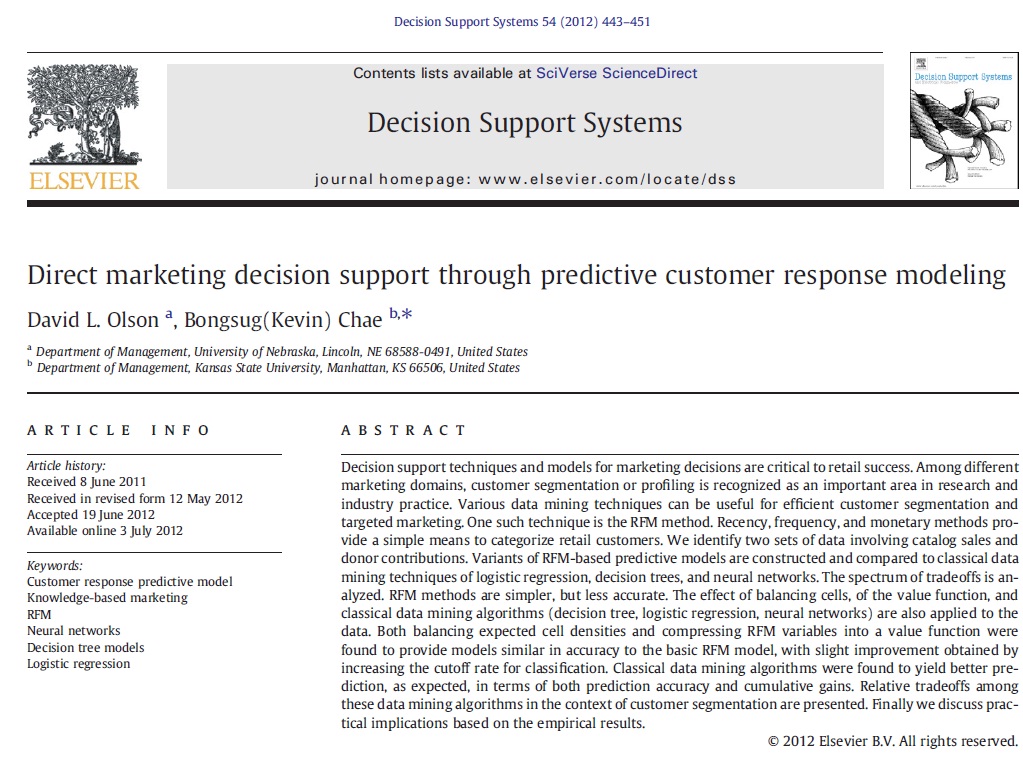
Direct marketing decision support through predictive customer response modeling
پشتیبانی تصمیم گیری بازاریابی مستقیم از طریق مدل سازی پیش بینی پاسخ مشتری
David L. Olson, Bongsug(Kevin) Chae
http://www.sciencedirect.com/science/article/pii/S0167923612001881
دانلود رایگان مقاله انگلیسی- تصمیم گیری بازاریابی مستقیم از طریق مدل سازی
چکیده
مدل ها و تکنیک های پشتیبانی تصمیم گیری در تصمیمات بازاریابی برای موفقیت های جزئی حیاتی هستند. در میان حوزه های بازاریابی مختلف، تقسیم بندی یا پروفایل مشتریان به عنوان یک منطقه ی مهم در عملیات صنعت و تحقیقات به رسمیت شناخته شده است. تکنیک های داده کاوی های مختلف می توانند برای تقسیم بندی مشتریان کارآمد و بازاریابی هدفمند مفید باشند. یکی از این تکنیک ها، روش RFM است. روش تأخیر، فرکانس و مالی یک معنای ساده برای دسته بندی مشتریان جزئی ارائه می کند. ما دو قسمت داده را شناسایی می کنیم که درگیر فروش های کاتالوگی و مشارکت های اهدایی می باشد. انواع دیگری از مدل های پیش بینی براساس RFM ساخته شده و با تکنیک های داده کاوی کلاسیک از رگرسیون منطقی، درخت های تصمیم گیری و شبکه های عصبی مقایسه شده است. طیفی از مبادلات تجزیه و تحلیل می شود. روش های RFM ساده تر هستند اما صحت کمتر دارند. اثر سلول های تعادلی از تابع ارزش و الگوریتم های داده کاوی کلاسیک (درخت تصمیم گیری، رگرسیون منطقی، شبکه های عصبی) نیز در داده ها اعمال شده اند. هر دو تراکم سلولی مورد انتظار تعادلی و متغیرهای RFM فشرده به یک تابع ارزش، در ارائه مدل های مشابه دقیق برای مدل RFM پایه با بهبود اندک بدست آمده ازطریق افزایش نرخ برشی برای طبقه بندی یافت شدند. الگوریتم های داده کاوی کلاسیک برای پیش بینی عملکرد بهتر، همانطور که انتظار می رفت، در شرایط هم صحت پیش بینی و هم سود انباشته یافت شدند. مبادلات نسبی در میان این الگوریتم های داده کاوی در زمینه تقسیم بندی مشتریان ارائه شده است. در نهایت ما مفاهیم عملی مبتنی بر نتایج تجربی را مورد بحث قرار می دهیم.
کلمات کلیدی:مدل پیش بینی پاسخ مشتری، بازاریابی بر اساس دانش،RFM،شبکه های عصبی مدل های درخت تصمیم گیری،رگرسیون منطقی.
Abstract
Decision support techniques and models for marketing decisions are critical to retail success. Among different marketing domains, customer segmentation or profiling is recognized as an important area in research and industry practice. Various data mining techniques can be useful for efficient customer segmentation and targeted marketing. One such technique is the RFM method. Recency, frequency, and monetary methods provide a simple means to categorize retail customers. We identify two sets of data involving catalog sales and donor contributions. Variants of RFM-based predictive models are constructed and compared to classical data mining techniques of logistic regression, decision trees, and neural networks. The spectrum of tradeoffs is analyzed. RFM methods are simpler, but less accurate. The effect of balancing cells, of the value function, and classical data mining algorithms (decision tree, logistic regression, neural networks) are also applied to the data. Both balancing expected cell densities and compressing RFM variables into a value function were found to provide models similar in accuracy to the basic RFM model, with slight improvement obtained by increasing the cutoff rate for classification. Classical data mining algorithms were found to yield better prediction, as expected, in terms of both prediction accuracy and cumulative gains. Relative tradeoffs among these data mining algorithms in the context of customer segmentation are presented. Finally we discuss practical implications based on the empirical results.
Highlights
Different RFM models and variants can be implemented.
Predictive modeling techniques using R, F, M variables tend to outperform RFM models.
Decision trees are especially attractive in that they have easily understood output.
More effective marketing decisions can be made using advanced predictive modeling techniques.
Keywords
Customer response predictive model; Knowledge-based marketing; RFM; Neural networks; Decision tree models; Logistic regression
Recommended articles
Monte Carlo analysis of estimation methods for the prediction of customer response patterns in direct marketing
2012, European Journal of Operational Research
Segmentation approaches in data-mining: A comparison of RFM, CHAID, and logistic regression
2007, Journal of Business Research
Quantitative models for direct marketing: A review from systems perspective
2009, European Journal of Operational Research