ترجمه مدیریت -20 صفحه
سال 2014
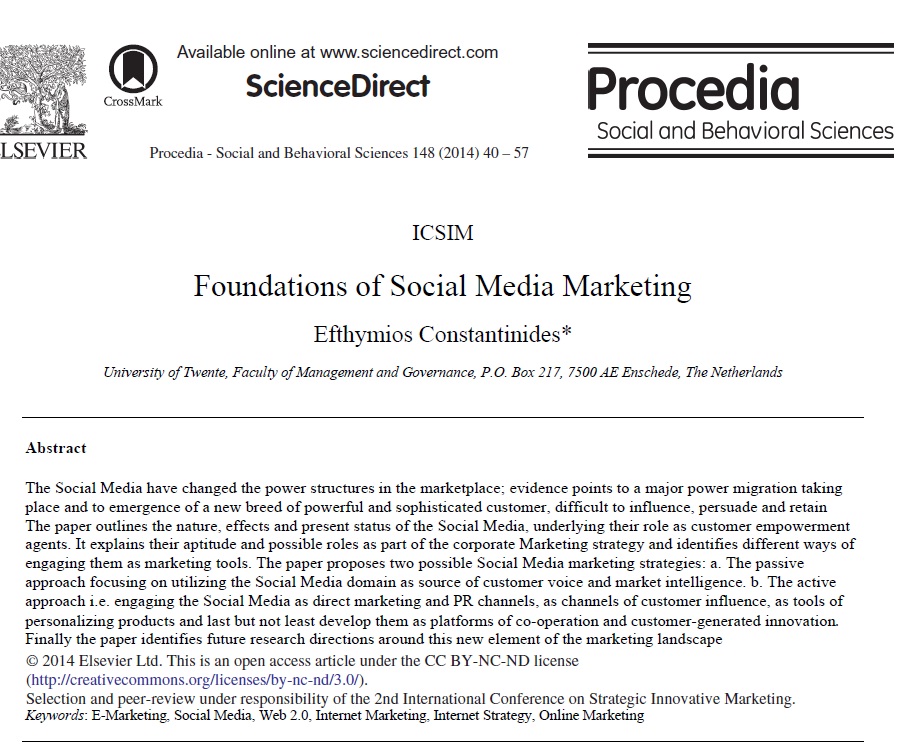
Foundations of Social Media Marketing
بنیان های بازاریابی رسانه های اجتماعی
Efthymios Constantinides
http://www.sciencedirect.com/science/article/pii/S1877042814039202
دانلود رایگان مقاله انگلیسی- بازاریابی رسانه های اجتماعی
چکیده :
رسانه های اجتماعی ساختارهای قدرت را در بازار تغییر داده اند . شواهد نشان دهنده ی انتقال قدرتی است که در حال رخ دادن است و ظهور نژاد جدیدی از مشتریان قدرتمند و پیشرفته ای که به سختی می توان آنها را تحت تاثیر قرار داد . آنها را متقاعد و یا حفظ نمود . این مقاله ماهیت تاثیرات و وضعیت حاظر رسانه های گروهی را بیان میدارد و بر نقش آنها به عنوان عوامل توانمندسازی مشتریان تاکید میکند . این مقاله استعدادها و نقش آنها به عنوان بخشی از استراتژی بازاریابی را توضیح می دهد و روشهای مختلف شرکت آنها به عنوان ابزارهای بازاریابی را نشان می دهد . این مقاله دو استراتژی بازاریابی رسانه های اجتماعی ممکن را پیشنهاد می کند :
روش انفعالی ( غیر فعال ) که بر به کارگیری حوزه ی رسانه های اجتماعی به عنوان منبع صدای مشتریان و هوش بازار تکیه میکند .
روش فعال یعنی شرکت دادن رسانه های اجتماعی به عنوان کانال های مستقیم بازاریابی و کانالهای تاثیرات مشتریان به عنوان ابزارهای شخصی سازی محصولات و آماده سازی آنها به عنوان سکوی همکاری و ابتکارات ساخت مشتریان است . در پایان این مقاله جهت دهی های تحقیقات آینده را در حول این عنصر جدید بازاریابی را شناسایی می کند .
کلمات کلیدی :بازاریابی الکترونیکی ، رسانه های اجتماعی ، بازاریابی اینترنتی ، استراتژی اینترنتی ، بازاریابی آنلاین .
Abstract
The Social Media have changed the power structures in the marketplace; evidence points to a major power migration taking place and to emergence of a new breed of powerful and sophisticated customer, difficult to influence, persuade and retain The paper outlines the nature, effects and present status of the Social Media, underlying their role as customer empowerment agents. It explains their aptitude and possible roles as part of the corporate Marketing strategy and identifies different ways of engaging them as marketing tools. The paper proposes two possible Social Media marketing strategies: a. The passive approach focusing on utilizing the Social Media domain as source of customer voice and market intelligence. b. The active approach i.e. engaging the Social Media as direct marketing and PR channels, as channels of customer influence, as tools of personalizing products and last but not least develop them as platforms of co-operation and customer-generated innovation. Finally the paper identifies future research directions around this new element of the marketing landscape
Keywords
E-Marketing; Social Media; Web 2.0; Internet Marketing; Internet Strategy; Online Marketing
References
Agichtein et al., 2008
E. Agichtein, C. Castillo, D. Donato, A. Gionis, G. MishneFinding High-Quality Content in Social MediaProceedings WDSM’08 (2008)
Albors et al., 2008
J. Albors, J.C. Ramos, J.L. HervasNew learning network paradigm: Communities of objectives, croudsourcing, wikis and open sourceInternational Journal of Information Management, 28 (2008), pp. 194-202
ArticlePDF (454KB)
ALTIME Group, 2009
ALTIMETER Group (2009), The world's most valuable brands. Who's most engaged? www.engagement.com.
Anderson, 2006
C. AndersonThe Long Tail, Why the future of business is selling less of moreHyperion, New York (2006)
Anderson, 2007
Anderson, P. (2007) ‘What is Web 2.0? Ideas, technologies and implications for education’, JISC Technology and Standards Watch, February 2007. http://www.educause.edu/ir/library/pdf/ERM0621.pdf.
Bakos, 1998
Y. BakosThe Emerging Role of Electronic Marketplaces on the InternetCommunications of the ACM, August 1998. (1998)
Baldoni, 2009
Baldoni J., (2009), What executives can learn from Obama's BlackBerry, Harvard Business Publishing online, http://blogs.harvardbusiness.org/baldoni/2009/01/a_virtual_leadership_lesson_ob.html?loomia_ow=t0:a38:g26:r2:c0.031242:b20799989.
Barwise, 2003
P. Barwise, A. StylerMarketing Expenditure Trends: 2001-2004.London Business School. (2003)
Bernhoff and Li, 2008
J. Bernhoff, C. LiHarnessing the Power of the Oh-So-Social WebMIT Sloan Management Review, 49 (3) (2008), pp. 36-42
Birdsall, 2007
Birdsall, W.F. (2007): Web 2.0 as a social movement, in: Webology, Vol. 4, No 2, http://www.webology.ir/2007/v4n2/a40.html.
Boudreau and Lakhani, 2009
K. Boudreau, K. LakhaniHow to manage outside innovationMIT Sloan Management review, 50 (4) (2009), pp. 68-76
Brady and Davis, 1993
J. Brady, I. DavisMarketing's mid-life crisisThe McKinsey Quarterly, 2 (1993), pp. 17-28
Bush, 2004
J. BushConsumer Empowerment and Competitiveness, (October)National Consumer Council London (2004)
Chaffey et al., 2000
D. Chaffey, R. Mayer, K. Johnston, F. Ellis-ChadwickInternet Marketing, StrategyImplementation and Practice, FT/Pretnice Hall (2000), pp. 40-48 151-168
Chen and Xie, 2008
Y. Chen, J. XieOnline consumer review; a new element of marketing communications mixManagement Science, 54 (3) (2008), p. 477491
Chesbrough, 2003
H. ChesbroughThe Era of Open InnovationMIT Sloan Management Review, 44 (3) (2003), pp. 41-45
Chesbrough, 2006
H. ChesbroughOpen business models: How to thrive in the new innovation landscape, Boston: Harvard Business School Press Christensen C.M., (1998)The Innovator's Dilemma, Harvard Business School Press, Cambridge, MA (2006)
Christensen and Raynor, 2003
C. Christensen, M. RaynorInnovator's Solution. Creating and sustaining successful growthHarvard Business School Press (2003)
Christopher, 1989
M. ChristopherThe Existential ConsumerEuropean Journal of Marketing, 23 (8) (1989), pp. 80-84
Constantinides, 2004
E. ConstantinidesInfluencing The Online Consumer's Behaviour: The Web ExperienceJournal of Internet Research, Internet Research, 14 (2) (2004), pp. 111-126
Constantinides and Geurts, 2005
E. Constantinides, P. GeurtsThe impact of Web Experience on virtual buying behavior: An empirical studyJournal of Customer Behavior, 4 (3.) (2005), pp. 307-335
Constantinides, 2006
E. ConstantinidesThe Marketing Mix Revisited: Towards the 21st Century MarketingJournal of Marketing Management, 22 (3–4) (2006), pp. 407-438
Constantinides and Fountain, 2008
E. Constantinides, S. FountainWeb 2.0: Conceptual Foundations and Marketing Issues, Journal of DirectData and Digital Marketing Practice, 9 (3.) (2008)
Coviello and Brodie, 2001
N.E. Coviello, R.J. BrodieContemporary marketing practices of consumer and business-to-business firms: how different are they?The Journal of Business and Industrial Marketing, 16 (5) (2001), pp. 382-400
<Court, 2007
Court D., (2007), The evolving role of the CMO, The McKinsey Quarterly, http://www.mckinseyquarterly.com/The_evolving_role_of_the_CMO_2031.
Davis, 1989
F.D. DavisPerceived usefulness, perceived ease of use and user acceptance of Information TechnologyMIS Quarterly, 13 (3) (1989), pp. 319-340
Deighton and Kornfeld, 2009
J. Deighton, L. KornfeldInteractivity's unanticipated consequences for marketers and marketingJournal of Interactive Marketing, 23 (2009), pp. 4-10
ArticlePDF (238KB)
Dellarocas, 2003
C. DellarocasThe digitalization of word of mouth: promise and challenges of online feedback mechanismsManagement Science, 49 (10) (2003), pp. 1407-1424 2003
Drury, 2008
G. DruryOpinion piece: Social media: Should marketers engage and how can it be done effectively?In Journal of Direct, Data and Digital Marketing Practice, 9 (3) (2008), pp. 274-277
Gefen et al., 2003a
D. Gefen, E. Karahanna, D.W. StraubInexperience and experience with online Stores: The importance of TAM and TrustIEE Transactions on Engineering Management, 50 (3) (2003), pp. 307-321
Gefen et al., 2003b
D. Gefen, E. Karahanna, D.W. StraubTrust y TAM in online shopping: An integrated ModelMIS Quarterly, 27 (1) (2003), pp. 51-90
Gillin, 2007
P. GillinThe New Influencers, a marketer's guide to the New Social mediaQuill Driver Books\Word Dancer Press Inc, CA, USA (2007)
Gillin, 2009
P. GillinSecrets of Social Media Marketing: How to Use Online Conversations and Customer Communities to Turbo-Charge Your Business!Quill Driver Books, Fresno, CA (2009)
Godin, 2007
S. GodinMeatball Sundae: Is your marketing out of sync?Portfolio (Penguin Group), USA (2007)
Grönroos, 1994
C. GrönroosQuo Vadis, Marketing? Toward a Relationship Marketing ParadigmJournal of Marketing Management, 10 (1994), pp. 347-360
Grönroos, 1997
C. GrönroosFrom Marketing Mix to Relationship Marketing – Towards a Paradigm Shift in MarketingManagement Decision 32/2, MCB University Press (1997)
Gummesson, 2008
E. GummessonCustomer centricity: reality or a wild goose chase?European Business Review, 20 (4) (2008), pp. 315-330
Heaton, 2006
T. HeatonTV News in a postmodern world: new metrics and principles (2006)
Hippel von and Katz, 2002
E. Hippel von, R. KatzShifting innovation to users via toolkitsManagement Science, 48 (2002), pp. 821-833
Kaplan and Haenlein, 2009
A. Kaplan, M. HaenleinConsumer Use and Business Potential of Virtual Worlds: The case of second LifeInternational Journal on Media Management, 11 (3) (2009), pp. 93-101
Kera, 1997
A. Kera, E. KaynakMarkets of a Single Customer: Exploiting Conceptual Developments in Market SegmentationEuropean Journal of Marketing, 31 (11/12) (1997), pp. 873-885
King and He, 2006
W.R. King, J. HeUnderstanding the role and methods of metaanalysis in IS researchCommunications of the AIS’06, 43 (2006), pp. 740-755
ArticlePDF (667KB)
Kim and Bae, 2008
J.H. Kim, Z. BaeThe role of online brand community in new product development: case studies on digital product manufacturers in KoreaInternational Journal if Innovation Management, 12 (3) (2008), pp. 357-376
Koufaris, 2002
M. KoufarisApplying the Technology Acceptance Model and Flow Theory to Online Consumer BehaviorInformation Systems Research, 13 (2) (2002), pp. 205-223
Kumar, 2004
N. KumarMarketing as StrategyUnderstanding the CEO's Agenda for Driving Growth and Innovation, Harvard Business School Press, Boston, MA (2004)
Lariscy et al., 2009
R. Lariscy, E. Avery, K. Sweetser, P. HowesAn examination of the role of online social media in journalists’ source mixPublic Relations Review, 35 (3) (2009), pp. 314-316
ArticlePDF (95KB)
Lee et al., 2008
J. Lee, D.-H. Park, I. HanThe effect of negative online consumer reviews on product attitude: An information processing viewElectronic Commerce Research and Applications, 7 (3) (2008), pp. 341-352
ArticlePDF (212KB)
Libert and Faulk, 2009
B. Libert, R. FaulkBarack Inc. Winning business lessons of the Obama campaignFinancial Times Press (2009)
Mathieson, 1991
K. MathiesonPredicting user intentions: Comparing the Technology Acceptance Model with the Theory of Planned BehaviorInformation Systems Research, 2 (3) (1991), pp. 173-191
Mangold and Faulds, 2009
W.G. Mangold, D. FauldsSocial media: The new hybrid element of the promotion mixBusiness Horizons, 52 (4) (2009), pp. 357-365
ArticlePDF (207KB)
McKinsey, 2007a
McKinseyHow businesses are using Web 2.0: A McKinsey global surveyThe McKinsey Quarterly (2007)
McKinsey, 2007b
McKinseyHow companies can make the most of user-generated contentThe McKinsey Quarterly (2007), p. 2007 August 2007
McKinsey, 2008a
McKinseyBuilding the Web 2.0 Enterprise: McKinsey Global Survey ResultsThe McKinsey Quarterly (2008) July 2008
McKinsey, 2008b
McKinseyThe next step in Open InnovationThe McKinsey Quarterly (2008) June 2008
Musser and O’Reilly, 2006
Musser J., O’Reilly T., (2006), Web 2.0 principles and Best Practices, O’Reilly Radar Report, ISBN 0-596-52769-1.
Nambisan and Nambisan, 2008
S. Nambisan, P. NambisanHow to Profit From a Better ‘Virtual Customer Environment’MIT Sloan Management Review, 49 (3) (2008), pp. 53-61
O’Reilly, 2005
O’Reilly T., (2005), What is Web 2.0? http://www.oreillynet.com/pub/a/oreilly/tim/news/2005/09/30/what-is-web-20.html.
Parise and Guinan, 2008
S. Parise, P.J. GuinanMarketing using Web 2.0Proceedings of the 41st Hawaii International Conference on System Sciences (2008)
Piller and Walcher, 2006
F. Piller, D. WalcherToolkits for idea competitions: a novel method to integrate users in new product developmentR&D Management, 36 (3) (2006), pp. 307-318
Porter, 1985
M.E. PorterCompetitive Advantage: Creating and Sustaining Superior PerformanceThe Tree Press, NY (1985)
Porter, 2001
Porter M.E., (2001), Strategy and the Internet, Harvard Business Review, March 2001.
Prahalad and Krishnan, 2008
C.K. Prahalad, M.S. KrishnanThe new age of innovation: Driving co-created value through Global NetworksMcGraw-Hill (2008)
Prahalad and Ramaswamy, 2004
D.K. Prahalad, V. RamaswamyCo-creation Experiences, The next practice in value creationJournal of Interactive Marketing, 18 (3) (2004), pp. 5-14
Rha et al., 2002
J.-Y. Rha, R. Widdows, N.H. Hooker, C.P. MontaltoE-consumerism as a tool for empowermentJournal of Consumer Education, 19 (20) (2002), pp. 61-69
Sharma and Sheth, 2004
A. Sharma, J. ShethWeb-based marketing:The coming revolution in marketing thought and strategy Journal of Business Research, 57 (7) (2004), pp. 696-702
ArticlePDF (143KB)
Sheth and Sisodia, 1995
J. Sheth, R. SisodiaThe productivity crisis in marketingMarketing Management, 4 (2) (1995), pp. 9-23
Singh et al., 2008
T. Singh, L. Veron-Jackson, L. CullinaneBlogging: A new play in your marketing game plan Business Horizons, 51 (4) (2008), pp. 281-292
ArticlePDF (189KB)
Shih and Fang, 2004
Y. Shih, K. FangThe use of a decomposed Theory of Planned Behavior to study Internet banking in TaiwanInternet Research: Electronic Networking Applications and Policy, 14 (3) (2004), pp. 213-223
Steinfield et al., 2009
C. Steinfield, J. DiMicco, N. Ellison, C. LampeC&T 2009Penn State University, PA, USA (2009)
Stelzner, 2009
Stelzner M., (2009), Social Media Marketing Industry Report, How marketers are using social Media to grow their business, www.Whitepapersource.com.
Thomas, 2007
A.R. ThomasThe end of mass marketing: or, why all successful marketing is now direct marketing. Direct Marketing:An International Journal, 1 (1) (2007), pp. 6-16
Urban, 2005
G. UrbanDon’t Just Relate - Advocate!: A Blueprint for Profit in the Era of Customer PowerWharton School Publishing, USA (2005)
Venkatesh and Davis, 2000
V. Venkatesh, F.D. DavisA theoretical extension of the Technology Acceptance Model: Four Longitudinal Field StudiesManagement Science, 46 (2) (2000), pp. 186-204
Vijayasarathy, 2004
L.R. VijayasarathyPredicting consumer intentions to use online shopping: The case for an augmented technology acceptance modelInformation&Management, 41 (6) (2004), pp. 747-762
ArticlePDF (214KB)
Willis et al., 2008
T. Willis, D. Coovert, C. Nelson, P. Spector, D. Rohrer, T. ShimizuAn Evaluation of the Technology Acceptance Model as a Means of Understanding Online Social Networking BehaviorTesis Doctoral. Estados Unidos. (2008)
Wind and Mahajan, 1997
J. Wind, V. MahajanIssues and opportunities in new product development: An introduction to the special issueJournal of Marketing Research, 34 (1997), pp. 1-12
Winer, 2009
R. WinerNew Communications Approaches in Marketing:Issues and Research Directions Journal of Interactive Marketing, 23 (2) (2009), pp. 108-117
ArticlePDF (290KB)
Zabin, 2009
Zabin J., (2009) The ROI of Social Media Marketing:Why it pays to drive word of Mouth, Aberdeen Group, www.adberdeen.com.