ترجمه مدیریت - 9 صفحه
سال 2014
Social Compliance and Corporate Legitimacy Within Supply Chains: A Theoretical Framework
فصل4 -اجابت اجتماعی و حقانیت سازمانی در زنجیره های تامین: یک چارچوب نظری
Muhammad Azizul Islam
http://link.springer.com/chapter/10.1007%2F978-3-319-09997-2_4
دانلود رایگان مقاله انگلیسی - اجابت اجتماعی و حقانیت سازمانی در زنجیره های تامین
نمونه متن ترجمه شده
بحث در فصل قبل، منجر به بررسی چارچوب نظری میشود که در صدد درک انگیزه های مدیریتی زیربنای حسابداری اجابت اجتماعی، گزارش دهی و شیوه های حسابرسی سازمان میباشد. برای کسب درک عمیق از چنین انگیزه هایی برای منبع یابی محصولات شرکت ها از عرضه کنندگان واقع در ملتهای در حال توسعه، این فصل، نظریه حقانیت را مطرح مینماید. نظریه حقانیت ، نظریه مناسب برای درک حسابداری اجتماعی و شیوه های گزارش دهی توسط بسیاری از محققان حسابداری محیط زیست و اجتماعی، محسوب میگردد.
Abstract
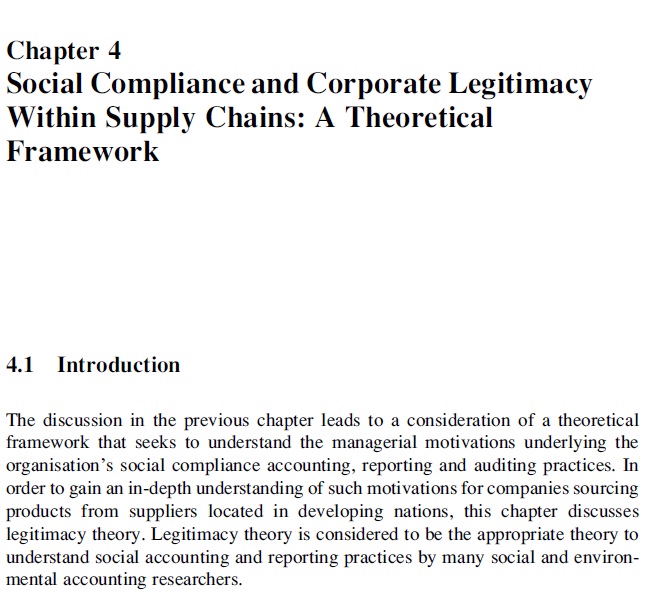
The discussion in the previous chapter leads to a consideration of a theoretical framework that seeks to understand the managerial motivations underlying the organisation’s social compliance accounting, reporting and auditing practices. In order to gain an in-depth understanding of such motivations for companies sourcing products from suppliers located in developing nations, this chapter discusses legitimacy theory. Legitimacy theory is considered to be the appropriate theory to understand social accounting and reporting practices by many social and environmental accounting researchers.
Reference
Adams C (2008) A commentary on: corporate social responsibility reporting and reputation risk management. Account Audit Account J 21(3):365–70CrossRef
Bebbington J, Larrinaga-Gonzalez C, Moneva-Abadia J (2008) Corporate social responsibility reporting and reputation risk management. Account Audit Account J 21(3):337–62CrossRef
Blackburn S (1996) The Oxford dictionary of philosophy. Oxford University Press, Oxford
Bowles M (1991) The organization shadow. Organ Stud 12:387–404CrossRef
Brown N, Deegan C (1998) The public disclosure of environmental performance information: a dual test of media agenda setting theory and legitimacy theory. Account Bus Res 29(1):21–41CrossRef
Deegan C, Rankin M, Voght P (2000) Firms disclosure reactions to major social incidents: Australian evidence. Acc Forum 24(1):101–130CrossRef
Deegan C (2002) The legitimizing effect of social and environmental disclosures: a theoretical foundation. Account Audit Account J 15(3):282–311CrossRef
Deegan C (2006) Financial accounting theory, 2nd edn. McGraw Hill, Sydney
Deegan C, Gordon B (1996) A study of the environmental disclosure practices of Australian corporations. Account Bus Res 26(3):187–99CrossRef
Deegan C, Rankin M (1997) The materiality of environmental information to users of annual reports. Account Audit Account J 10(4):562–83CrossRef
Deegan C, Rankin M, Tobin J (2002) An examination of the corporate social and environmental disclosures BHP from 1983–1997: a test of legitimacy theory. Account Audit Account J 15(3):312–43CrossRef
Donaldson T (1982) Corporations and morality. Prentice-Hall, Englewood Cliffs, NJ
Dowling J, Pfeffer J (1975) Organizational legitimacy: social values and organizational behaviour. Pac Socio Rev 18(1):122–36CrossRef
Gamble A (1995) The new political economy. Polit Stud 43(4):516–30CrossRef
Gray R, Kouhy R, Lavers S (1995) Corporate social and environmental reporting: a review of the literature and a longitudinal study of UK disclosure. Account Audit Account J 8(2):47–77CrossRef
Gray R, Owen D, Adams C (1996) Accounting and accountability: social and environmental accounting in a changing World. Prentice Hall, Hemel Hempstead
Guthrie J, Parker L (1989) Corporate social reporting: a rebuttal of legitimacy theory. Account Bus Res 9(76):343–52CrossRef
Hobbes T (1994) Leviathan. In: Curley E (eds), Indianapolis: Hacket, Orig. pub. 1651
Hogner R (1982) Corporate social reporting: eight decades of development in US steel. Res Corporate Perform Pol 4:243–50
Hybels R (1995) On legitimacy, legitimation, and organizations: a critical review and integrative theoretical model. Acad Manage J 1995(Special issue):241–45
Lindblom C (1994) The implications of organizational legitimacy for corporate social performance and disclosure. Critical Perspectives on Accounting Conference, New York, NY
Locke J (1993) Two treatises of government. In: Goldie M (eds), Everyman London, Orig. published in 1689.
Mathews M (1993) Socially responsible accounting. Chapman & Hall, London
Murphy C, Tooze R (1991) Getting beyond the “Common Sense” of the IPE Orthodoxy. In: Murphy C, Tooze R (eds) The new international political economy. Lynne Rienner, Boulder, USA
Nasi T, Nasi S, Phillips N, Zyglidopoulos S (1997) The evolution of corporate social responsiveness: an exploratory study of Finnish and Canadian Forestry Companies. Bus Society 38(3):296–321CrossRef
Newson M, Deegan C (2002) Global expectations and their association with corporate social disclosure practices in Australia, Singapore and South Korea. Int J Account 37:183–213CrossRef
O’Donovan G (1999) Managing legitimacy through increased corporate environmental reporting: an exploratory study. Interdiscipl Environ Rev 1(1):63–99CrossRef
O’Donovan G (2002) Environmental disclosures in the annual report: extending the applicability and predictive power of legitimacy theory. Account Audit Account J 15(3):344–71CrossRef
Patten D (1991) Exposure, legitimacy, and social disclosure. J Account Publ Pol 10:297–308CrossRef
Patten D (1992) Intra-industry environmental disclosure in response to the Alaska oil spill: a note on legitimacy theory. Account Org Soc 17:471–75CrossRef
Patten D (1995) Variability in social disclosure: a legitimacy-based analysis. Adv Publ Interest Account 6:273–85
Rousseau J (1996) On the social contract. In: Wootton D (ed) Modern political thought: readings from Machiavelli to Nietzsche. Hackett, Indianapolis
Sethi S (1974) Corporate social policy in a dynamic society: the options available to business. In: Sethi S (ed) The unstable ground: corporate social policy in a dynamic society. Melvill Publishing Company, Los Angeles, CA, pp 1–5
Sethi S (1977) Dimensions of corporate social performance: an analytical framework. In: Carroll A (ed) Managing corporate social responsibility. Little Brown, Boston, MA
Shocker A, Sethi S (1974) An approach to incorporating social preferences in developing corporate action strategies. In: Sethi S (ed) The unstable ground: corporate social policy in a dynamic society. Melvill Publishing Company, Los Angeles, CA, pp 67–80
Suchman M (1995) Localism and globalism in institutional analysis: the emergence of contractual norms in venture finance. In: Scott W, Chriatensen S (eds) The institutional construction of organizations: international and longitudinal studies. Sage, Thousand Oaks, CA, pp 39–66
Walden W, Schwartz B (1997) Environmental disclosures and public policy pressure. J Account Public Pol 16:125–54CrossRef