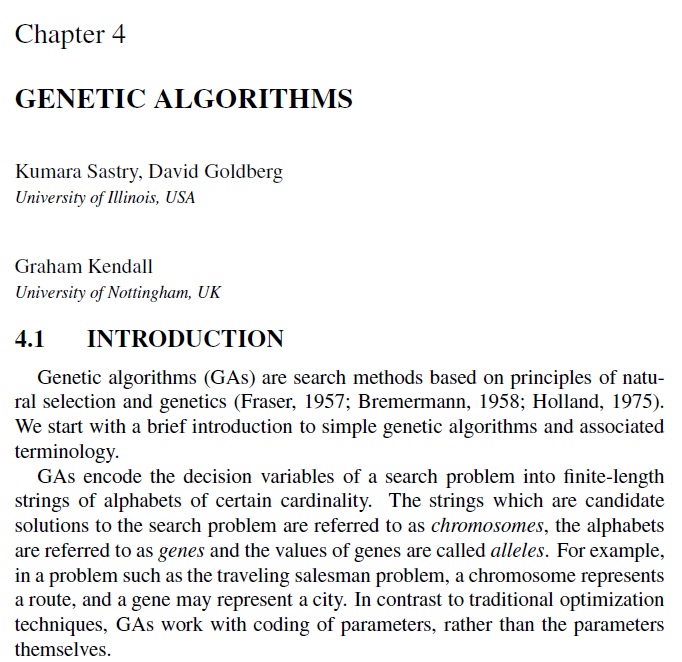
الگوریتم ژنتیک یک روش تحقیقاتی بر اساس اصول انتخاب طبیعی و ژنتیک است.ما بایک مقدمه ای ساده به سوی الگوریتم ژنتیک و اصطلاحات علمی پیوند داده شده با آن،شروع میکنیم.الگوریتم ژنتیک در ردیف متناهی از الفبا،در اعداد اصلی و در راستای متناهی بررسی میشود.ردیفی که کاندیدی برای تحقیق در مورد مسائل است به کروموزوم اشاره دارد وحروف الفبا به ژن اشاره دارد وارزش ژن به آلل وابسته است. برای مثال در یک مسئله فروشنده سیار که در آن یک کرومزوم نشان دهنده مسیر است و ژن نشان دهنده یک شهر میباشد که در مقایسه با فن بهینه سازی،سنتی GAبا کد کردن یک پارامتر از خود پارامتر سریعتر عمل میکند. در باز کردن یک ترکیب خوب ما به معیار تمایز ترکیب خوب از ترکیب بد نیاز داریم.معیار ممکن است یک هدف متغیر که وابسته به مدل ریاضی باشد یا شبیه به یک کامپیوتر یا میتواند یک ساخته ذهنی باشد که انسان برای غلبه بر ترکیبهای غلط انتخاب کرده است.در ذات یک معیار خوب باید یک روش در تکامل به وسیله GA صورت گیرد.مفهوم مهم دیگر GA خانواده یک جمعیت است. بر خلاف روشهای سنتی تحقیق GA به جمعیت داوطلب تکیه دارد. اندازه جمعیت که همیشه یک پارامتر خاص است یکی از مهمترین فاکتورهای اثر گذاری در درجه پیشرفت الگوریتم ژنتیک است. برای مثال جمعیت کوچک امکان یک همگرایی نابهنگام و راه حل غیر استاندارد را ایجاد میکند. به عبارت دیگر جمعیتهای بزرگ به هزینه های غیر ضروری و افزایش زمان شمارش ها منتهی میگردد.
Abstract
Genetic algorithms (GAs) are search methods based on principles of natural selection and genetics (Fraser, 1957; Bremermann, 1958; Holland, 1975). We start with a brief introduction to simple genetic algorithms and associated terminology.
Reference
Asoh, H. and Mühlenbein, H., 1994, On the mean convergence time of evolutionary algorithms without selection and mutation, Parallel Problem Solving from Nature III, Lecture Notes in Computer Science, Vol. 866, pp. 98–107.
Bäck, T., 1995, Generalized convergence models for tournament—and (μ, λ)—selection, Proc. 6th Int. Conf. on Genetic Algorithms, pp. 2–8.
Bäck, T., Fogel, D. B. and Michalewicz, Z., 1997, Handbook of Evolutionary Computation, Oxford University Press, Oxford.MATH
Baker, J. E., 1985, Adaptive selection methods for genetic algorithms, Proc. Int. Conf. on Genetic Algorithms and Their Applications, pp. 101–111.
Baluja, S., 1994, Population-based incremental learning: A method of integrating genetic search based function optimization and competitive learning, Technical Report CMU-CS-94-163, Carnegie Mellon University.
Barthelemy, J.-F. M. and Haftka, R. T., 1993, Approximation concepts for optimum structural design—a review, Struct. Optim. 5:129–144.CrossRef
Beasley, D., Bull, D. R. and Martin, R. R., 1993, An overview of genetic algorithms: Part 1, fundamentals, Univ. Comput. 15:58–69.
Blickle, T. and Thiele, L., 1995, A mathematical analysis of tournament selection, Proc. 6th Int. Conf. on Genetic Algorithms, pp. 9–16.
Booker, L. B., Fogel, D. B., Whitley, D. and Angeline, P. J., 1997, Recombination, in: The Handbook of Evolutionary Computation, T. Bäck, D. B. Fogel, and Z. Michalewicz, eds, chapter E3.3, pp. C3.3:1–C3.3:27, IOP Publishing and Oxford University Press, Philadelphia, PA.
Bosman, P. A. N. and Thierens, D., 1999, Linkage information processing in distribution estimation algorithms, Proc. 1999 Genetic and Evolutionary Computation Conf., pp. 60–67.
Bremermann, H. J., 1958, The evolution of intelligence. The nervous system as a model of its environment, Technical Report No. 1, Department of Mathematics, University of Washington, Seattle, WA.
Bulmer, M. G., 1985, The Mathematical Theory of Quantitative Genetics, Oxford University Press, Oxford.
Burke, E. K. and Newall, J. P., 1999, A multi-stage evolutionary algorithm for the timetable problem, IEEE Trans. Evol Comput. 3:63–74.CrossRef
Burke, E. K. and Smith, A. J., 1999, A memetic algorithm to schedule planned maintenance, ACM J. Exp. Algor. 41, www.jea.acm.org/1999/BurkeMemetic/ ISSN 1084-6654.
Burke, E. K. and Smith, A. J., 2000, Hybrid Evolutionary Techniques for the Maintenance Scheduling Problem, IEEE Trans. Power Syst. 15:122–128.CrossRef
Burke, E. K., Elliman, D. G. and Weare, R.F., 1995, Specialised recombinative operators for timetabling problems, in: Evolutionary Computing: AISB Workshop 1995 T. Fogarty, ed., Lecture Notes in Computer Science, Vol. 993, pp. 75–85, Springer, Berlin.
Burke, E. K., Newall, J. P. and Weare, R. F., 1996, A memetic algorithm for university exam timetabling, in: The Practice and Theory of Automated Timetabling I, E. K. Burke and P. Ross, eds, Lecture Notes in Computer Science, Vol. 1153, pp. 241–250, Springer, Berlin.
Burke, E. K., Newall, J. P. and Weare, R. F., 1998, Initialisation strategies and diversity in evolutionary timetabling, Evol. Comput. J. (special issue on Scheduling) 6:81–103.
Burke, E. K., Cowling, P. I., De Causmaecker, P. and Vanden Berghe, G., 2001, A memetic approach to the nurse rostering problem, Appl. Intell. 15:199–214.MATHCrossRef
Cantü-Paz, E., 1997, A summary of research on parallel genetic algorithms IlliGAL Report No. 97003, General Engineering Department, University of Illinois at Urbana-Champaign, Urbana, IL.
Cantú-Paz, E., 1999, Migration policies and takeover times in parallel genetic algorithms, in: Proc. Genetic and Evolutionary Computation Conf., p. 775, Morgan Kaufmann, San Francisco.
Cantú-Paz, E., 2000, Efficient and Accurate Parallel Genetic Algorithms, Kluwer, Boston, MA.MATH
Cheng, R. W. and Gen, M., 1997, Parallel machine scheduling problems using memetic algorithms, Comput. Indust. Eng., 33:761–764.CrossRef
Coley, D. A., 1999, An Introduction to Genetic Algorithms for Scientists and Engineers, World Scientific, New York.
Costa, D., 1995, An evolutionary tabu search algorithm and the nhl scheduling problem, INFOR 33:161–178.MATH
Crow, J. F. and Kimura, M., 1970, An Introduction of Population Genetics Theory, Harper and Row, New York.
Davis, L., 1985, Applying algorithms to epistatic domains, in: Proc. Int. Joint Conf. on Artifical Intelligence, pp. 162–164.
Davis, L. D. (ed), 1987, Genetic Algorithms and Simulated Annealing, Pitman, London.MATH
Davis, L. (ed), 1991, Handbook of Genetic Algorithms, Van Nostrand Reinhold, New York.
De Jong, K. A., 1975, An analysis of the behavior of a class of genetic adaptive systems, Doctoral Dissertation, University of Michigan, Ann Arbor, MI (University Microfilms No. 76-9381) (Dissertation Abs. Int. 36:5140B).
Deb, K. and Goldberg, D. E., 1994, Sufficient conditions for deceptive and easy binary functions, Ann. Math. Artif. Intell. 10:385–408.MATHCrossRefMathSciNet
Falkenauer E., 1998, Genetic Algorithms and Grouping Problems, Wiley, New York.
Fitzpatrick, J. M., Grefenstette, J. J. and Van Gucht, D., 1984, Image registration by genetic search, in: Proc. IEEE Southeast Conf., IEEE, Piscataway, NJ, pp. 460–464.
Fleurent, C. and Ferland, J., 1994, Genetic hybrids for the quadratic assignment problem, in: DIMACS Series in Mathematics and Theoretical Computer Science, Vol. 16, pp. 190–206.MathSciNet
Fogel, D. B., 1998, Evolutionary Computation: The Fossil Record, IEEE, Piscataway, NJ.MATH
Forrest, S., 1993, Genetic algorithms: Principles of natural selection applied to computation, Science 261:872–878.CrossRef
Fraser, A. S., 1957, Simulation of genetic systems by automatic digital computers. II: Effects of linkage on rates under selection, Austral. J. Biol. Sci. 10:492–499.
Goldberg, D. E., 1983, Computer-aided pipeline operation using genetic algorithms and rule learning, Doctoral Dissertation,. University of Michigan, Ann Arbor, MI.
Goldberg, D. E., 1987, Simple genetic algorithms and the minimal deceptive problem, in: Genetic Algorithms and Simulated Annealing, L. Davis, ed., chapter 6, pp. 74–88, Morgan Kaufmann, Los Altos, CA.
Goldberg, D. E., 1989a, Genetic algorithms and Walsh functions: Part II, deception and its analysis, Complex Syst. 3:153–171.MATH
Goldberg, D. E., 1989b, Genetic Algorithms in Search Optimization and Machine Learning, Addison-Wesley, Reading, MA.MATH
Goldberg, D. E., 1989c, Sizing populations for serial and parallel genetic algorithms, in: Proc. 3rd Int. Conf. on Genetic Algorithms, pp. 70–79.
Goldberg, D. E., 1999a, The race, the hurdle, and the sweet spot: Lessons from genetic algorithms for the automation of design innovation and creativity, in: Evolutionary Design by Computers, P. Bentley, ed., chapter 4, pp. 105–118, Morgan Kaufmann, San Mateo, CA.
Goldberg, D. E., 1999b, Using time efficiently: Genetic-evolutionary algorithms and the continuation problem, in: Proc. Genetic and Evolutionary Computation Conf., pp. 212–219.
Goldberg, D. E., 2002, Design of Innovation: Lessons From and For Competent Genetic Algorithms, Kluwer, Boston, MA.MATH
Goldberg, D. E. and Deb, K., 1991, A comparative analysis of selection schemes used in genetic algorithms, Foundations of Genetic Algorithms, G. J. E. Rawlins, ed., pp. 69–93.
Goldberg, D. E., Deb, K. and Clark, J. H., 1992a, Genetic algorithms, noise, and the sizing of populations, Complex Syst. 6:333–362.MATH
Goldberg, D. E., Deb, K. and Horn, J., 1992b, Massive multimodality, deception, and genetic algorithms, Parallel Problem Solving from Nature II, pp. 37–46, Elsevier, New York.
Goldberg, D. E., Deb, K., Kargupta, H. and Harik, G., 1993, Rapid, accurate optimization of difficult problems using fast messy genetic algorithms, in: Proc. Int. Conf on Genetic Algorithms, pp. 56–64.
Goldberg, D. E., Korb, B. and Deb, K., 1989, Messy genetic algorithms: Motivation, analysis, and first results. Complex Syst. 3:493–530.MATHMathSciNet
Goldberg, D. E. and Lingle, R., 1985, Alleles, loci, and the TSP, in: Proc. 1st Int. Conf. on Genetic Algorithms, pp. 154–159.
Goldberg, D. E. and Rudnick, M., 1991, Genetic algorithms and the variance of fitness, Complex Syst. 5:265–278.MATH
Goldberg, D. E. and Sastry, K., 2001, A practical schema theorem for genetic algorithm design and tuning, in: Proc. of the Genetic and Evolutionary Computation Conf., pp. 328–335.
Goldberg, D. E., Sastry, K. and Latoza, T., 2001, On the supply of building blocks, in: Proc. of the Genetic and Evolutionary Computation Conf., pp. 336–342.
Goldberg, D. E. and Segrest, P., 1987, Finite Markov chain analysis of genetic algorithms, in: Proc. 2nd Int. Conf. on Genetic Algorithms, pp. 1–8.
Goldberg, D. E. and Voessner, S., 1999, Optimizing global-local search hybrids, in: Proc. of the Genetic and Evolutionary Computation Conf., pp. 220–228.
Gorges-Schleuter, M., 1989, ASPARAGOS: An asynchronous parallel genetic optimization strategy, in: Proc. 3rd Int. Conf. on Genetic Algorithms, pp. 422–428.
Gorges-Schleuter, M., 1997, ASPARAGOS96 and the traveling salesman problem, in: Proc. IEEE Int. Conf. on Evolutionary Computation, pp. 171–174.
Grefenstette, J. J., 1981, Parallel adaptive algorithms for function optimization, Technical Report No. CS-81-19, Computer Science Department, Vanderbilt University, Nashville, TN.
Grefenstette, J. J. and Baker, J. E., 1989, How genetic algorithms work: A critical look at implicit parallelism, in: Proc. 3rd Int. Conf. on Genetic Algorithms, pp. 20–27.
Grefenstette, J. J. and Fitzpatrick, J. M., 1985, Genetic search with approximate function evaluations, in: Proc. Int. Conf. on Genetic Algorithms and Their Applications, pp. 112–120.
Harik, G. R., 1997, Learning linkage to eficiently solve problems of bounded difficulty using genetic algorithms, Doctoral Dissertation, University of Michigan, Ann Arbor, MI.
Harik, G., 1999, Linkage learning via probabilistic modeling in the ECGA, IlliGAL Report No. 99010, University of Illinois at Urbana-Champaign, Urbana, IL.
Harik, G., Cantú-Paz, E., Goldberg, D. E. and Miller, B. L., 1999, The gambler’s ruin problem, genetic algorithms, and the sizing of populations, Evol. Comput. 7:231–253.
Harik, G. and Goldberg, D. E., 1997, Learning linkage, Foundations of Genetic Algorithms, 4:247–262.
Harik, G., Lobo, F. and Goldberg, D. E., 1998, The compact genetic algorithm, in: Proc. IEEE Int. Conf. on Evolutionary Computation, pp. 523–528.
Hart, W. E. and Belew, R. K., 1996, Optimization with genetic algorithm hybrids using local search, in: Adaptive Individuals in Evolving Populations, R. K. Belew, and M. Mitchell, eds, pp. 483–494, Addison-Wesley, Reading, MA.
Hart, W., Krasnogor, N. and Smith, J. E. (eds), 2004, Special issue on memetic algorithms, Evol. Comput. 12 No. 3.
Heckendorn, R. B. and Wright, A. H., 2004, Efficient linkage discovery by limited probing, Evol. Comput. 12:517–545.CrossRef
Holland, J. H., 1975, Adaptation in Natural and Artificial Systems, University of Michigan Press, Ann Arbor, MI.
Ibaraki, T., 1997, Combinations with other optimization methods, in: Handbook of Evolutionary Computation, T. Bäck, D. B. Fogel, and Z. Michalewicz, eds, pp. D3:1–D3:2, Institute of Physics Publishing and Oxford University Press, Bristol and New York.
Jin, Y., 2003, A comprehensive survey of fitness approximation in evolutionary computation, Soft Comput. J. (in press).
Kargupta, H., 1996, The gene expression messy genetic algorithm, in: Proc. Int. Conf. on Evolutionary Computation, pp. 814–819.
Krasnogor, N., Hart, W. and Smith, J. (eds), 2004, Recent Advances in Memetic Algorithms, Studies in Fuzziness and Soft Computing, Vol. 166, Springer, Berlin.
Krasnogor, N. and Smith, J. E., 2005, A tutorial for competent memetic algorithms: model, taxonomy and design issues, IEEE Trans. Evol. Comput., accepted for publication.
Louis, S. J. and McDonnell, J., 2004, Learning with case injected genetic algorithms, IEEE Trans. Evol. Comput. 8:316–328.CrossRef
Larrañaga, P. and Lozano, J. A. (eds), 2002, Estimation of Distribution Algorithms, Kluwer, Boston, MA.MATH
Lin, S.-C., Goodman, E. D. and Punch, W. F., 1997, Investigating parallel genetic algorithms on job shop scheduling problem, 6th Int. Conf. on Evolutionary Programming, pp. 383–393.
Man, K. F., Tang, K. S. and Kwong, S., 1999, Genetic Algorithms: Concepts and Design, Springer, London.MATH
Manderick, B. and Spiessens, P., 1989, Fine-grained parallel genetic algorithms, in: Proc. 3rd Int. Conf. on Genetic Algorithms, pp. 428–433.
Memetic Algorithms Home Page: http://www.densis.fee.unicamp.br/~moscato/memetic
home.html
Michalewicz, Z., 1996, Genetic Algorithms + Data Structures = Evolution Programs, 3rd edn, Springer, Berlin.MATH
Miller, B. L. and Goldberg, D. E., 1995, Genetic algorithms, tournament selection, and the effects of noise, Complex Syst. 9:193–212.MathSciNet
Miller, B. L. and Goldberg, D. E., 1996a, Genetic algorithms, selection schemes, and the varying effects of noise, Evol. Comput. 4:113–131.
Miller, B. L. and Goldberg, D. E., 1996b, Optimal sampling for genetic algorithms, Intelligent Engineering Systems through Artificial Neural Networks (ANNIE’96), Vol. 6, pp. 291–297, ASME Press, New York.
Mitchell, M., 1996, Introduction to Genetic Algorithms, MIT Press, Boston, MA.
Moscato, P., 1989, On evolution, search, optimization, genetic algorithms and martial arts: Towards memetic algorithms, Technical Report C3P 826, Caltech Concurrent Computation Program, California Institute of Technology, Pasadena, CA.
Moscato, P., 1999, Part 4: Memetic algorithms, in: New Ideas in Optimization, D. Corne, M. Dorigo and F. Glover, eds, pp. 217–294, McGraw-Hill, New York.
Moscato, P., 2001, Memetic algorithms, in: Handbook of Applied Optimization, Section 3.6.4, P. M. Pardalos and M. G. C. Resende, eds, Oxford University Press, Oxford.
Moscato, P. and Cotta, C., 2003, A gentle introduction to memetic algorithms, in: Handbook of Metaheuristics, F. Glover and G. Kochenberger, eds, Chapter 5, Kluwer, Norwell, MA.
Mühlenbein, H. and Paaß, G., 1996, From recombination of genes to the estimation of distributions I. Binary parameters, in: Parallel Problem Solving from Nature IV, Lecture Notes in Computer Science, Vol. 1141, Springer, Berlin.
Mühlenbein, H. and Schlierkamp-Voosen, D., 1993, Predictive models for the breeder genetic algorithm: I. continous parameter optimization, Evol. Comput. 1:25–49.
Munetomo, M. and Goldberg, D. E., 1999, Linkage identification by non-monotonicity detection for overlapping functions, Evol. Comput. 7:377–398.
Oliver, J. M., Smith, D. J. and Holland, J. R. C., 1987, A study of permutation crossover operators on the travelling salesman problem, in: Proc. 2nd Int. Conf. on Genetic Algorithms, pp. 224–230.
Paechter, B., Cumming, A., Norman, M. G. and Luchian, H., 1996, Extensions to a memetic timetabling system, The Practice and Theory of Automated Timetabling I, E. K. Burke and P. Ross, eds, Lecture Notes in Computer Science, Vol. 1153, Springer, Berlin, pp. 251–265.
Paechter, B., Cumming, A. and Luchian, H., 1995, The use of local search suggestion lists for improving the solution of timetable problems with evolutionary algorithms, Evolutionary Computing: AISB Workshop 1995, T. Fogarty, ed., Lecture Notes in Computer Science, Vol. 993, Springer, Berlin, pp. 86–93.
Pelikan, M., 2005, Hierarchical Bayesian Optimization Algorithm: Toward a New Generation of Evolutionary Algorithm, Springer, Berlin.MATH
Pelikan, M. and Goldberg, D. E., 2001, Escaping hierarchical traps with competent genetic algorithms, in: Proc. Genetic and Evolutionary Computation Conf., pp. 511–518.
Pelikan, M., Goldberg, D. E. and Cantú-Paz, E., 2000, Linkage learning, estimation distribution, and Bayesian networks, Evol. Comput. 8:314–341.CrossRef
Pelikan, M., Lobo, F. and Goldberg, D. E., 2002, A survey of optimization by building and using probabilistic models, Comput. Optim. Appl. 21:5–20.MATHCrossRefMathSciNet
Pelikan, M. and Sastry, K., 2004, Fitness inheritance in the Bayesian optimization algorithm, in: Proc. Genetic and Evolutionary Computation Conference, Vol. 2, pp. 48–59.
Pettey, C. C, Leuze, M. R. and Grefenstette, J. J., 1987, A parallel genetic algorithm, in: Proc. 2nd Int. Conf. on Genetic Algorithms, pp. 155–161.
Radcliffe, N. J. and Surry, P. D., 1994, Formal memetic algorithms, Evolutionary Computing: AISB Workshop 1994, T. Fogarty, ed., Lecture Notes in Computer Science, Vol. 865, pp. 1–16, Springer, Berlin.
Reeves, C. R., 1995, Genetic algorithms, in: Modern Heuristic Techniques for Combinatorial Problems, C. R. Reeves, ed., McGraw-Hill, New York.
Robertson, G. G., 1987, Parallel implementation of genetic algorithms in a classifier system, in: Proc. 2nd Int. Conf. on Genetic Algorithms, pp. 140–147.
Rothlauf, F., 2002, Representations for Genetic and Evolutionary Algorithms, Springer, Berlin.MATH
Rudolph, G., 2000, Takeover times and probabilities of non-generational selection rules, in: Proc. Genetic and Evolutionary Computation Conf., pp. 903–910.
Sakamoto, Y. and Goldberg, D. E., 1997, Takeover time in a noisy environment, in: Proc. 7th Int. Conf. on Genetic Algorithms, pp. 160–165.
Sastry, K., 2001, Evaluation-relaxation schemes for genetic and evolutionary algorithms, Master’s Thesis, General Engineering Department, University of Illinois at Urbana-Champaign, Urbana, IL.
Sastry, K. and Goldberg, D. E., 2002, Analysis of mixing in genetic algorithms: A survey, IlliGAL Report No. 2002012, University of Illinois at Urbana-Champaign, Urbana, IL.
Sastry, K. and Goldberg, D. E., 2003, Scalability of selectorecombinative genetic algorithms for problems with tight linkage, in: Proc. 2003 Genetic and Evolutionary Computation Conf., pp. 1332–1344.
Sastry, K. and Goldberg, D. E., 2004a, Designing competent mutation operators via probabilistic model building of neighborhoods, in: Proc. 2004 Genetic and Evolutionary Computation Conference II, Lecture Notes in Computer Science, Vol. 3103, Springer, Berlin, pp. 114–125.
Sastry, K. and Goldberg, D. E., 2004b, Let’s get ready to rumble: Crossover versus mutation head to head, in: Proc. 2004 Genetic and Evolutionary Computation Conf. II, Lecture Notes in Computer Science, Vol. 3103, Springer, Berlin, pp. 126–137.
Sastry, K., Goldberg, D. E., & Pelikan, M., 2001, Don’t evaluate, inherit, in: Proc. Genetic and Evolutionary Computation Conf., pp. 551–558.
Sastry, K., Pelikan, M. and Goldberg, D. E., 2004, Efficiency enhancement of genetic algorithms building-block-wise fitness estimation, in: Proc. IEEE Int. Congress on Evolutionary Computation, pp. 720–727.
Smith, R., Dike, B. and Stegmann, S., 1995, Fitness inheritance in genetic algorithms, in: Proc. ACM Symp. on Applied Computing, pp. 345–350, ACM, New York.
Spears, W., 1997, Recombination parameters, in: The Handbook of Evolutionary Computation, T. Bäck, D. B. Fogel and Z. Michalewicz, eds, Chapter E1.3, IOP Publishing and Oxford University Press, Philadelphia, PA, pp. E1.3:1–E1.3:13.
Spears, W. M. and De Jong, K. A., 1994, On the virtues of parameterized uniform crossover, in: Proc. 4th Int. Conf. on Genetic Algorithms.
Srivastava, R. and Goldberg, D. E., 2001, Verification of the theory of genetic and evolutionary continuation, in: Proc. Genetic and Evolutionary Computation Conf., pp. 551–558.
Syswerda, G., 1989, Uniform crossover in genetic algorithms, in: Proc. 3rd Int. Conf. on Genetic Algorithms, pp. 2–9.
Thierens, D., 1999, Scalability problems of simple genetic algorithms, Evol. Comput. 7:331–352.
Thierens, D. and Goldberg, D. E., 1994a, Convergence models of genetic algorithm selection schemes, in: Parallel Problem Solving from Nature III, pp. 116–121.
Thierens, D. and Goldberg, D. E., 1994b, Elitist recombination: An integrated selection recombination GA, in: Proc. 1st IEEE Conf. on Evolutionary Computation, pp. 508–512.
Thierens, D., Goldberg, D. E. and Pereira, A. G., 1998, Domino convergence, drift, and the temporal-salience structure of problems, in: Proc. IEEE Int. Conf. on Evolutionary Computation, pp. 535–540.
Valenzuala, J. and Smith, A. E., 2002, A seeded memetic algorithm for large unit commitment problems, J. Heuristics, 8:173–196.CrossRef
Voigt, H.-M., Mühlenbein, H. and Schlierkamp-Voosen, D., 1996, The response to selection equation for skew fitness distributions, in: Proc. Int. Conf. on Evolutionary Computation, pp. 820–825.
Watson, J. P., Rana, S., Whitely, L. D. and Howe, A. E., 1999, The impact of approximate evaluation on the performance of search algorithms for ware-house scheduling, J. Scheduling, 2:79–98.MATHCrossRef
Whitley, D., 1995, Modeling hybrid genetic algorithms, in Genetic Algorithms in Engineering and Computer Science, G. Winter, J. Periaux, M. Galan and P. Cuesta, eds, Wiley, New York, pp. 191–201.
Yu, T.-L., Goldberg, D. E., Yassine, A. and Chen, Y.-P., 2003, A genetic algorithm design inspired by organizational theory: Pilot study of a dependency structure matrix driven genetic algorithm, Artificial Neural Networks in Engineering (ANNIE 2003), pp. 327–332.
منابع اطلاعاتی اضافه شده:
چند نرم افزار:
GARAGe, http://garage.cps.msu.edu/. Genetic Algorithms Research
and Applications Group.
LGADOS in Coley (1999).
NeuroDimension, http://www.nd.com/genetic/
116 SASTRY, GOLDBERG AND KENDALL
Simple GA (SGA) in Goldberg (1989b).
Solver.com, http://www.solver.com/
Ward Systems Group Inc., http://www.wardsystems.com/
موارد معرفی دیگر:
see Holland (1975), Davis (1987), Goldberg (1989b), Davis
(1991), Beasley et al. (1993), Forrest (1993), Reeves (1995), Michalewicz
(1996), Mitchell (1996), Falkenauer (1998), Coley (1999), and Man
et al. (1999).
الگوریتم MEMTIC:
Radcliffe and Surry (1994), Moscato (1999, 2001), Moscato and Cotta (2003),
Hart et al. (2004), Krasnogor et al. (2004), Krasnogor and Smith (2005).
You might also like to refer to the Memetic Algorithms Home Page at
http://www.densis.fee.unicamp.br/∼moscato/memetic home.html
نویسنده:
Evolutionary Computation, http://mitpress.mit.edu/
catalog/item/default.asp?tid=25&ttype=4
Genetic Programming and Evolvable Machines,
http://www.kluweronline.com/issn/1389-2576/contents
الگوریتم ژنتیک:
IEEE Transactions on Evolutionary Computation,
http://www.ieee-nns.org/pubs/tec/
کنفرانس:
Congress on Evolutionary Computation (CEC)
Genetic and Evolutionary Computation Conference (GECCO)
Parallel Problem Solving in Nature (PPSN)
Simulated Evolution and Learning (SEAL)