ترجمه کامپیوتر- 16 صفحه
سال 2010
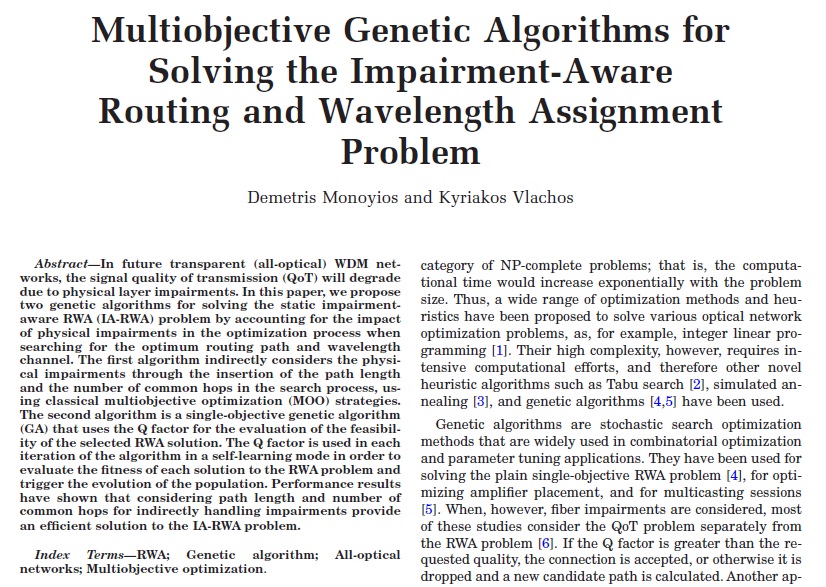
Multiobjective Genetic Algorithms for Solving the Impairment-Aware Routing
الگوریتم ژنتیک چند منظوره برای حل مسئله ریشه یابی اختلال - هوشمندی و تخصیص طول موج
Demetris Monoyios and Kyriakos Vlachos
http://ieeexplore.ieee.org/document/5672463
دانلود رایگان مقاله انگلیسی - الگوریتم ژنتیک چند منظوره
چکیده:
در شبکه های شفاف WDM (تمام نوری) آتی کیفیت سیگنال انتقال (QOT) به خاطر اختلالات لایه ای فیزیکی کاهش خواهد یافت. در این مقاله دو الگوریتم ژنتیک برای حل مسئله اختلالات هوشمندی استاتیک (IA,RWA) با در نظر گرفتن تأثیر اختلالات عصبی در پروسه بهینه سازی حین تحقیق در مورد مسیریابی و کانال طول موج مطرح نمودیم. الگوریتم اول به طور غیر مستقیم اختلالات فیزیکی در طول مسیر و تعداد جهش های مشترک در پروسه تحقیق را در نظر گرفته و از دسته اثری های بهینه سازی چند منظوره (Moo) کلاسیک استفاده می کند. الگوریتم دوم این الگوریتم ژنتیک تک منظوره (GA) است که از فاکتور Q برای ارزیابی امکان پذیری حل RWA انتخاب شده استفاده می کند. فاکتور Q در هر تکرار الگوریتم در حالت خود یادگیری به کار می رود تا فیتنس (انطباق) هر حل بامسئله RWA ارزیابی شده و تکامل جمعیت راه اندازی شود. نتایج کارایی نشان مید هد که طول مسیر مورد بررسی و تعداد جهش های مشترک برای اختلالات غیر مستقیم حل موثری برای مسئله RWA، IA فراهم می کند.
واژگان کلیدی: RWA، الگوریتم ژنتیک، شبکه های تمام نوری، بهینه سازی چند منظوره.
Abstract:
In future transparent (all-optical) WDM networks, the signal quality of transmission (QoT) will degrade due to physical layer impairments. In this paper, we propose two genetic algorithms for solving the static impairment-aware RWA (IA-RWA) problem by accounting for the impact of physical impairments in the optimization process when searching for the optimum routing path and wavelength channel. The first algorithm indirectly considers the physical impairments through the insertion of the path length and the number of common hops in the search process, using classical multiobjective optimization (MOO) strategies. The second algorithm is a single-objective genetic algorithm (GA) that uses the Q factor for the evaluation of the feasibility of the selected RWA solution. The Q factor is used in each iteration of the algorithm in a self-learning mode in order to evaluate the fitness of each solution to the RWA problem and trigger the evolution of the population. Performance results have shown that considering path length and number of common hops for indirectly handling impairments provide an efficient solution to the IA-RWA problem.
Keywords