ترجمه عمران - 18 صفحه
سال 2011
Self-compacting concrete incorporating filler additives Performance
عملکرد در دماهای بالای بتن خود تراکم ترکیب شده با مواد افزودنی پرکننده
http://www.sciencedirect.com/science/article/pii/S0950061811003473
Mucteba Uysal
دانلود رایگان مقاله انگلیسی - عملکرد در دماهای بالای بتن خود تراکم
چکیده :
یک تحقیق آزمایشگاهی برای ارزیابی عملکرد بتن خود تراکم در معرض دمای بالا قرار گرفته انجام شد.برای این منظور سیمان پرتلند با موادی نظیر پودر سنگ آهک، پودر بازلت و پودر سنگ در نسبت های مختلف جایگزین گردید. نصف کل نمونه های هر نوع ترکیب با اضافه کردن الیاف پلی پروپیلن برای ارزیابی اثر این الیاف بر روی رفتار بتن خود تراکم در معرض دمای بالا قرار گرفته مورد مطالعه قرار گرفت.
سپس آزمایشی برای تعیین کاهش وزن و مقاومت فشاری روی آنها انجام شد.علاوه بر این تغییرات سرعت پالس مافوق صوت تعیین گردید ومشاهده ترکهای سطحی بعد از مواجه شدن با دماهای بالا انجام گردید.
نتایج آزمایشگاهی بیانگر کاهش شدید مقاومت بتن های خود تراکم بعد از مواجه شدن با دماهای بالاتر از ۶٠٠ درجه سانتی گراد بود.
Abstract
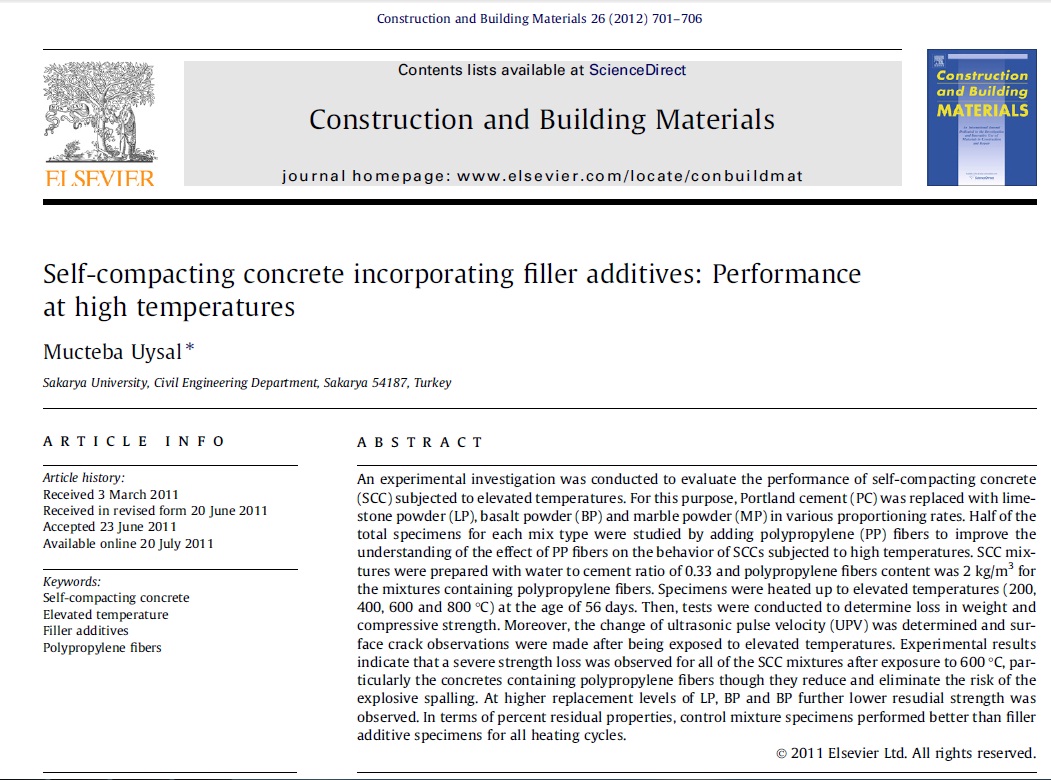
An experimental investigation was conducted to evaluate the performance of self-compacting concrete (SCC) subjected to elevated temperatures. For this purpose, Portland cement (PC) was replaced with limestone powder (LP), basalt powder (BP) and marble powder (MP) in various proportioning rates. Half of the total specimens for each mix type were studied by adding polypropylene (PP) fibers to improve the understanding of the effect of PP fibers on the behavior of SCCs subjected to high temperatures. SCC mixtures were prepared with water to cement ratio of 0.33 and polypropylene fibers content was 2 kg/m3 for the mixtures containing polypropylene fibers. Specimens were heated up to elevated temperatures (200, 400, 600 and 800 °C) at the age of 56 days. Then, tests were conducted to determine loss in weight and compressive strength. Moreover, the change of ultrasonic pulse velocity (UPV) was determined and surface crack observations were made after being exposed to elevated temperatures. Experimental results indicate that a severe strength loss was observed for all of the SCC mixtures after exposure to 600 °C, particularly the concretes containing polypropylene fibers though they reduce and eliminate the risk of the explosive spalling. At higher replacement levels of LP, BP and BP further lower resudial strength was observed. In terms of percent residual properties, control mixture specimens performed better than filler additive specimens for all heating cycles.
Highlights
SCC specimens were prepared with fillers and subjected to various temperature levels.
Limestone, basalt and marble powder were used as filler additives.
SCC mixes were also studied by adding polypropylene fibers.
Changes in compressive strength, UPV and weight of the specimens were investigated.
Control mixtures perform better than filler additive specimens for all heating cycles.
Keywords
Self-compacting concrete; Elevated temperature; Filler additives; Polypropylene fibers